



What are Zoho Books accounting services?
- Partner statusZoho Authorized
- Setup time3 to 5 working days
- Managed booksFrom ₹1,999/month
- SoftwareBilled by Zoho
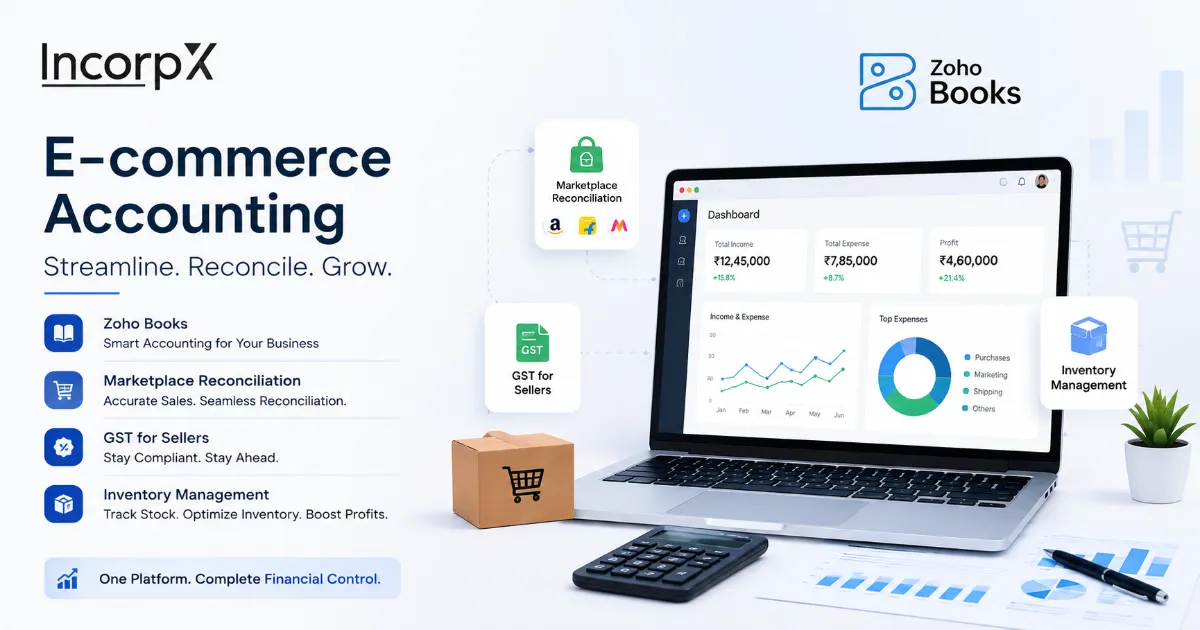
Zoho Books is cloud accounting software from Zoho Corporation, built for Indian GST rather than adapted to it. It handles invoicing, bills, banking, inventory, projects and reporting in a browser and on mobile, and it talks to the GST system directly because Zoho is a registered GST Suvidha Provider. That is the difference between exporting a JSON file and clicking a button: e-invoices go to the Invoice Registration Portal from inside the software and come back with an IRN and a signed QR code.
The software is the easy part. What separates a Zoho Books file that is still useful in year three from one that gets abandoned is the setup underneath it: a chart of accounts that maps to Schedule III so the year-end statements need no regrouping, tax masters that decide GST on every document instead of leaving it to whoever raises the invoice, and opening balances that agree with your last filed return. Those are the things a rushed self-setup skips, and the things an auditor finds later. In FY 2025-26 IncorpX implemented or migrated Zoho Books for 300+ businesses, with the migrated trial balance reconciled to the source system before every sign-off.
IncorpX is an independent Zoho Authorized Partner, not part of Zoho Corporation. Your subscription lives in your own Zoho account, so you keep the data, the administrator login and the billing relationship, and you can revoke our access at any time. Our fee covers professional services only. Pair the implementation with monthly bookkeeping for a fixed close, or with full accounting services when you also need statements and tax workings.
 Zoho Authorized Partner
 Your organisation, your login
The Zoho Books organisation is created under your own account, in the India data centre, with you as administrator. We work under a role you grant, which means nothing about your books is hostage to the engagement.
- You own the subscription and the administrator login
- Access is role-based and revocable at any time
- Full CSV and Excel export, with no exit fee from us
Legal framework
Audit trail: proviso to Rule 3(1), Companies (Accounts) Rules, 2014 (FY from 1 April 2023) | Auditor reporting: Rule 11(g), Companies (Audit and Auditors) Rules, 2014 | Books of account: Section 128, Companies Act, 2013 | GST records: Section 35 with Rule 56, CGST Act, 2017 | E-invoicing: ₹5 crore aggregate annual turnover threshold
What Zoho Books handles
Eight areas that matter to an Indian business, and what each one is actually configured to do during implementation.
| Module | What it does | Configured at setup |
|---|---|---|
| Sales and invoicing | Quotes, invoices, credit notes, recurring billing, payment reminders | Branded templates, Rule 46 mandatory fields, HSN or SAC, place of supply |
| Purchases and bills | Vendor bills, purchase orders, debit notes, expense capture | Vendor masters with GSTIN validation, TDS sections, approval flow |
| Banking | Bank and card feeds, matching rules, reconciliation statements | Read-only feeds for each account, matching rules for repeat entries |
| GST | Return summaries, GSTR-2B matching, reverse charge, exports and LUT | Rates and HSN or SAC masters, registration type, e-invoicing connection |
| Inventory | Items, price lists, reorder points, warehouses on higher plans | Item masters with codes, opening stock, valuation method |
| Projects and timesheets | Project costing, billable hours, retainer invoices | Project heads and billing method, where the business bills by time |
| Reporting | Profit and loss, balance sheet, cash flow, ageing, custom reports | Schedule III account grouping, scheduled monthly report delivery |
| Audit trail | Transaction log and edit log with dates and user details | Verified as active, since Rule 3(1) does not permit it to be off |
What implementation includes at every level
- Organisation, GSTIN, fiscal year and place of business setup
- Chart of accounts mapped to Schedule III presentation
- GST rates with HSN codes for goods and SAC codes for services
- Customer and supplier masters with GSTIN validation
- Branded invoice, estimate, credit note and receipt templates
- Read-only bank feeds and payment gateway connections
- E-invoicing and e-way bill connection where applicable
- Opening balances reconciled to your last filed position
- User roles and approval permissions for your team
- 2 live training sessions with recordings and a written runbook
Practitioner insight (IncorpX implementation team)
The three setup shortcuts that cost the most later are all masters problems: a generic chart of accounts that has to be regrouped at every year end, GST rates typed on the invoice instead of held on the item master, and vendor records without a validated GSTIN. Each one looks like it saves an hour at go-live and each one produces a monthly correction for as long as the file exists.
How Zoho Books setup runs
Ten steps across 3 to 5 working days for a standard business. Migration of historical data extends steps 5 and 9, taking the total to 7 to 15 working days.
Scope the implementation
Entity type, current software, number of GSTINs, monthly transaction volume, inventory needs and user count decide the Zoho Books plan and how much migration work is involved. A named accountant and an implementation lead are assigned the same day.
Create the Zoho Books organisation
Created under your own Zoho account so data and billing stay with you, with the correct fiscal year, base currency, GSTIN, place of business and registration type. Indian accounts are provisioned in the India data centre.
Build the chart of accounts
Built for your sector rather than lifted from a template, with account groups that map cleanly to Schedule III of the Companies Act, 2013, so the year-end financial statements need no regrouping and the auditor gets what they expect.
Import customers, suppliers and items
Contacts and item masters imported with GSTIN validation, duplicate ledgers merged and price lists set. Cleaning masters here is what removes the recurring monthly corrections that otherwise follow a business into its new system.
Brand the document templates
Invoice, estimate, credit note and receipt templates set up with your logo, terms and bank details, carrying every field a tax invoice must show under Rule 46, including HSN or SAC to the required number of digits.
Connect bank feeds and payment gateways
Read-only feeds for bank and card accounts plus any payment gateway you collect through. No operating credentials are stored, and each imported line is matched against a recorded invoice or bill rather than typed in a second time.
Enable e-invoicing and e-way bills
Zoho Corporation is registered as your GST Suvidha Provider on the portal, so invoices go to the Invoice Registration Portal for an IRN and signed QR code, and e-way bills generate from the invoice itself. Applies once aggregate turnover has crossed ₹5 crore in any year from 2017-18.
Load opening balances and reconcile
Balances taken from the last audited or filed position, then the trial balance reconciled line by line against the source system, with every difference traced to an entry rather than parked in suspense. You receive the reconciliation statement with the file.
Train the team and start the close
Two live sessions, one for the people raising documents and one for reviewers, with recordings and a runbook written for your specific setup. From the next period the monthly close runs inside Zoho Books, with the reporting pack out by the 10th.
Pick the go-live date deliberately
The cleanest cut-over is the first day of a quarter or a financial year, because the opening balances agree with a position you have already reported. A mid-month switch means running two systems in parallel for a few weeks and reconciling both, which is workable but doubles the review effort for that period.
Get Zoho Books set up properly
Talk to a Zoho Authorized Partner for free. Standard setup in 3 to 5 working days, waived when you take a monthly plan from ₹1,999.
Migrating from Tally, Excel or an older system
Most businesses arriving at Zoho Books are not starting from zero. The work is not the import; it is making the imported numbers agree with what was already filed.
| Source | What moves across | Typical duration | Notes |
|---|---|---|---|
| Tally Prime or Tally.ERP 9 | Masters, opening balances, current-year transactions, outstanding invoices and bills | 7 to 15 working days | Duplicate ledgers merged and GSTINs validated during the move |
| Excel or Google Sheets | Contacts, items, opening balances, open receivables and payables | 5 to 10 working days | Structure is usually rebuilt rather than copied |
| QuickBooks exports | Masters, balances and open items from the final export | 7 to 12 working days | Intuit discontinued QuickBooks in India from 30 April 2023 |
| Another cloud system | Masters, balances, open items and, where held, transaction history | 7 to 15 working days | Depends entirely on what the source will export |
| No system at all | Opening position rebuilt from bank statements and filed returns | 10 to 20 working days | Quoted as backlog work, priced per arrear month |
Most businesses migrate the current financial year in full detail and bring earlier years across as opening balances plus a read-only archive. That keeps the working file fast without losing the record, and it is enough for both the auditor and any assessment, because the statutory retention obligation is about being able to produce the records, not about holding them in one live system. Full multi-year transaction migration is possible and is quoted on record count.
Nothing is signed off until the migrated trial balance agrees with the source. Every difference is traced to the entry that caused it, not posted to a suspense account to be dealt with later, and you receive the reconciliation statement alongside the file. Your team keeps working in the old system until that sign-off, so no one stops invoicing while a migration runs.
Migration is the moment to clean up
A ledger list that has accumulated for eight years usually carries duplicate vendors, three spellings of the same customer, and item codes nobody uses. Migration is the only cheap opportunity to fix that, because the data is being touched anyway. Fixing it afterwards means restating history.
GST, e-invoicing and e-way bills
Zoho Corporation is a registered GST Suvidha Provider, which is why these run from inside the software instead of through a JSON file and a second portal login.
E-invoicing. An invoice is validated and pushed to the Invoice Registration Portal from within Zoho Books, and comes back carrying its Invoice Reference Number and a signed QR code. The obligation starts once aggregate annual turnover has crossed ₹5 crore in any financial year from 2017-18 onwards, and it keeps applying even if turnover later falls back below that line. It covers B2B supplies, exports and supplies to government entities. Businesses at ₹10 crore and above also face a 30-day limit for reporting an invoice to the portal. The detail is in our note on the e-invoice turnover limit.
E-way bills. Register Zoho Corporation as your GSP on the e-way bill portal and the bill generates from the invoice itself, carrying part A and part B details across without re-entry. The trigger is consignment value above ₹50,000 for inter-state movement, with each state setting its own intra-state rules.
Returns and reconciliation. GSTR-1 and GSTR-3B summaries are prepared inside Zoho Books and can be pushed from the software rather than re-keyed. Two things make this a monthly discipline rather than an annual one: from the July 2025 tax period the outward liability in GSTR-3B is non-editable, so a correction has to run through GSTR-1A before filing, and credit on an invoice for a financial year cannot be claimed after 30 November following that year under Section 16(4) of the CGST Act, 2017. See GST return filing assistance if you want the filing handled too.
| Requirement | Trigger | Where it happens in Zoho Books |
|---|---|---|
| GST registration | ₹40 lakh turnover for goods, ₹20 lakh for services, lower in special category states | GSTIN and registration type on the organisation |
| E-invoicing | Aggregate annual turnover above ₹5 crore in any year from 2017-18 | IRP push from the invoice, IRN and QR returned |
| 30-day IRP reporting limit | Aggregate annual turnover of ₹10 crore and above | Invoice date validation before submission |
| E-way bill | Consignment value above ₹50,000 inter-state, state rules intra-state | Generated from the invoice with Zoho registered as GSP |
| GSTR-2B reconciliation | Every GST-registered person, every tax period | Purchase register matched against the imported 2B |
| Input tax credit deadline | 30 November following the financial year, Section 16(4) | Mismatch report flags unclaimed credit by supplier |
The audit trail rule every company must meet
This is the provision that quietly ended spreadsheet accounting for companies, and the one your auditor now has to report on by name.
The proviso to Rule 3(1) of the Companies (Accounts) Rules, 2014 says that for financial years beginning on or after 1 April 2023, a company that uses accounting software to maintain its books must use software that does three things: record an audit trail of every transaction, create an edit log of each change with the date it was made, and make sure the audit trail cannot be disabled. It applies to companies. Proprietorships, partnership firms and LLPs are outside it, though the record-keeping duties under Section 34 of the LLP Act, 2008 still apply to LLPs.
It is not a self-assessment. Under Rule 11(g) of the Companies (Audit and Auditors) Rules, 2014, your statutory auditor must report whether the software had the feature, whether it operated throughout the year, and whether it was tampered with. A qualified remark there sits in the public record on the MCA portal alongside your financial statements.
Zoho Books carries an audit trail on every plan, including the Free plan. Verifying that it is on, and that no user role can switch it off, is part of implementation rather than something you discover during the audit. A spreadsheet cannot meet the test at all, which is the practical reason companies move off Excel whatever their size.
What Zoho Books gives you
- Every transaction logged: creation, modification and deletion are each recorded with the user and timestamp behind them.
- Edit log with dates: what changed, when, and from what value, which is exactly what Rule 3(1) asks for.
- Cannot be switched off: no user role, including the administrator, can turn the trail off inside Zoho Books.
- Available on every plan: including the Free plan, so a small company is not priced out of compliance.
- Auditor-ready: the log can be exported for the Rule 11(g) reporting your auditor has to complete.
What to watch for
- Spreadsheets fail outright: Excel and Google Sheets cannot produce a non-disableable edit log, so a company cannot rely on them as its books.
- Older desktop versions may not qualify: software predating the rule needs its version and configuration checked rather than assumed.
- Disabling it is a reportable default: if the trail was off for any part of the year, the auditor must say so under Rule 11(g).
- It does not replace review: a trail records what happened, it does not tell you whether the entry was right.
Which Zoho Books plan do you need?
These are Zoho Corporation prices, billed by Zoho under your own account. They are exclusive of local taxes and annual billing is cheaper, so confirm the current figure before you commit.
| Plan | Monthly price | Users | What it adds | Suits |
|---|---|---|---|---|
| Free | ₹0 | 1 + 1 accountant | Invoicing, expenses, bank reconciliation, GST returns, audit trail | Revenue within ₹25 lakh for the financial year |
| Standard | ₹899 | 3 | Recurring invoices, more automation, project timesheets | Service businesses and small traders |
| Professional | ₹1,799 | 5 | Inventory, purchase orders, a second GSTIN, sales orders | Businesses carrying stock or multiple registrations |
| Premium | ₹3,599 | 10 | Custom modules, vendor portal, advanced workflows | Growing teams with approval chains |
| Elite | ₹5,999 | 15 | Warehouse management, batch and serial tracking, barcodes | Multi-warehouse distribution and manufacturing |
| Ultimate | ₹9,599 | 25 | Advanced analytics on top of everything above | Larger operations needing built-in BI |
The Free plan is free indefinitely, not a trial, as long as revenue for the financial year stays within ₹25 lakh. It allows 1 user plus 1 accountant, and it carries the audit trail, which means a small private limited company can meet the Rule 3(1) requirement at zero software cost. Your IncorpX accountant normally occupies the dedicated accountant seat rather than one of your paid user slots, so taking us on does not push you up a plan.
Prices move. The current India rate card is published at zoho.com/in/books/pricing, and we confirm the right plan during scoping rather than selling you the largest one. Most businesses under ₹5 crore turnover sit comfortably on Standard or Professional.
Do not pick the plan on price alone
The commonest mistake is starting on Standard while carrying stock, then discovering at year end that there is no inventory valuation to put in the balance sheet. Inventory begins at Professional. Similarly, a second GSTIN is a plan feature, not an add-on, so a business registering in a new state needs to check the plan before it registers.
What connects to Zoho Books
The reason a business consolidates on one suite is not the software discount. It is that a record entered once stops being re-entered three more times.
Zoho Inventory
Stock, order management and shipping, sharing item masters with Books so a dispatch updates the ledger without a second entry.
Zoho Payroll
Salary computation, payslips, PF and ESI, posting the salary journal into Books automatically each month.
Zoho Expense
Employee claims and card spend with receipt capture, flowing into Books as approved reimbursements.
Zoho CRM
A won deal becomes a quote and then an invoice, so sales and finance are working from the same customer record.
Zoho Analytics
Dashboards across Books and the rest of the suite, for boards and lenders who want more than a static PDF.
Bank and gateway feeds
Read-only feeds from major Indian banks plus payment gateways, so statement lines import instead of being typed.
Payroll is the integration most businesses reach for second. If you would rather not run it yourself, HR and payroll management starts at ₹1,500 per month for up to 10 employees and posts into the same books. For a company that has outgrown reporting and wants forecasting and board packs, Virtual CFO support builds on the same data.
Zoho Books vs Tally Prime vs spreadsheets
IncorpX runs monthly books on both Zoho Books and Tally Prime at the same price, so this is a fit question rather than a sales one.
| Parameter | Zoho Books | Tally Prime | Spreadsheet |
|---|---|---|---|
| Deployment | Cloud, browser and mobile | Desktop, remote access add-on | File on a machine or drive |
| Works offline | Limited mobile capture | Yes | Yes |
| Automatic bank feeds | Yes | Statement import | No |
| Simultaneous multi-user access | From anywhere | On the licensed setup | Conflicts on edit |
| E-invoicing to the IRP | Direct, Zoho is a registered GSP | Supported | No |
| E-way bill generation | Yes | Yes | No |
| GSTR-2B reconciliation | Built in | Built in | Manual |
| Audit trail per Rule 3(1) | On every plan, cannot be disabled | Version dependent | No |
| Client sees live numbers | Real time | On request or remote session | Whenever the file is shared |
| Typical software cost | ₹0 to ₹9,599 per month | Perpetual licence plus renewal | Effectively nil |
| Best for | Remote teams wanting live books | Established finance teams and offline sites | Nothing, for a company |
The spreadsheet column is not a rhetorical device. A company literally cannot rely on Excel as its books of account for a financial year beginning on or after 1 April 2023, because the proviso to Rule 3(1) requires an audit trail that cannot be disabled and a spreadsheet cannot provide one. That is a compliance question rather than a preference.
Between the two real options, choose Zoho Books if your team is distributed, you want bank feeds and live numbers, or you already use other Zoho apps. Choose Tally Prime if your finance staff are fluent in it, or if a site has to keep invoicing when the connection drops. Read the wider picture in accounting basics for founders, or compare service levels on bookkeeping and accounting services.
Zoho Books guides and calculators
References behind a Zoho Books setup: what a tax invoice must carry, how e-invoicing works on the portal, the returns your software feeds, and the records and statements the configured chart of accounts has to produce.
Frequently asked questions about Zoho Books accounting
35 questions taken from real search queries, Zoho's published India documentation, and what businesses ask us during scoping calls.
Move your books to Zoho Books
Talk to a Zoho Authorized Partner for a free consultation. Setup in 3 to 5 working days, Tally and Excel migration with a reconciled trial balance, and managed books from ₹1,999 a month.




 Nebin Binoy