Bookkeeping for Startups in India: A 2026 Founder Guide
How to set up bookkeeping for a startup in India in 2026: Companies Act and income-tax rules, GST, TDS, audit trail, software, and when to outsource.


Documents Required
- Certificate of Incorporation
- Company PAN
- TAN, if applicable
- GST registration certificate, if applicable
- Business bank statements
- Sales invoices, purchase bills, and expense receipts
- Existing accounting data or previous books, if taking over from another accountant
Tools & Prerequisites
- Cloud accounting software such as Zoho Books or TallyPrime
- A dedicated business bank account with digital access
- A document store for bills, receipts, and contracts
- A compliance calendar for GST, TDS, and ROC due dates
Bookkeeping for a startup is the disciplined, day-to-day recording of every financial transaction, and for a registered Indian company it is a legal requirement from the date of incorporation, not an optional task. Under Section 128 of the Companies Act 2013, and now Section 62 of the Income Tax Act 2025, startups must keep proper books on the accrual basis, retain them for years, and use them to file GST, TDS, and annual returns. This guide explains what the law requires in 2026, what books to keep, how to set up bookkeeping from day one, and when it makes sense to outsource it.
- Bookkeeping is mandatory from incorporation under Section 128 of the Companies Act 2013, on the accrual basis with double-entry.
- The tax law changed in 2026: Section 62 of the Income Tax Act 2025 replaced Section 44AA from 1 April 2026. Companies must also keep a daily India-server backup of electronic books, a rule in force since 2022 under the Companies (Accounts) Rules.
- Audit trail is mandatory: since 1 April 2023, companies (including private limited) must use accounting software with a non-disableable edit log.
- Keep the core books: cash book, bank book, sales and purchase registers, ledger, and GST and TDS records, for at least 8 years.
- Separate business and personal money from day one; a dedicated bank account is the foundation of clean books.
- Poor books can be costly: Section 128(6) allows imprisonment up to one year, or a fine of ₹50,000 to ₹5 lakh, or both, on the officers in default, plus delayed due diligence and clean-up costs.
- Outsourcing is often cheaper than a full-time in-house accountant, and keeps the books accurate and compliant.
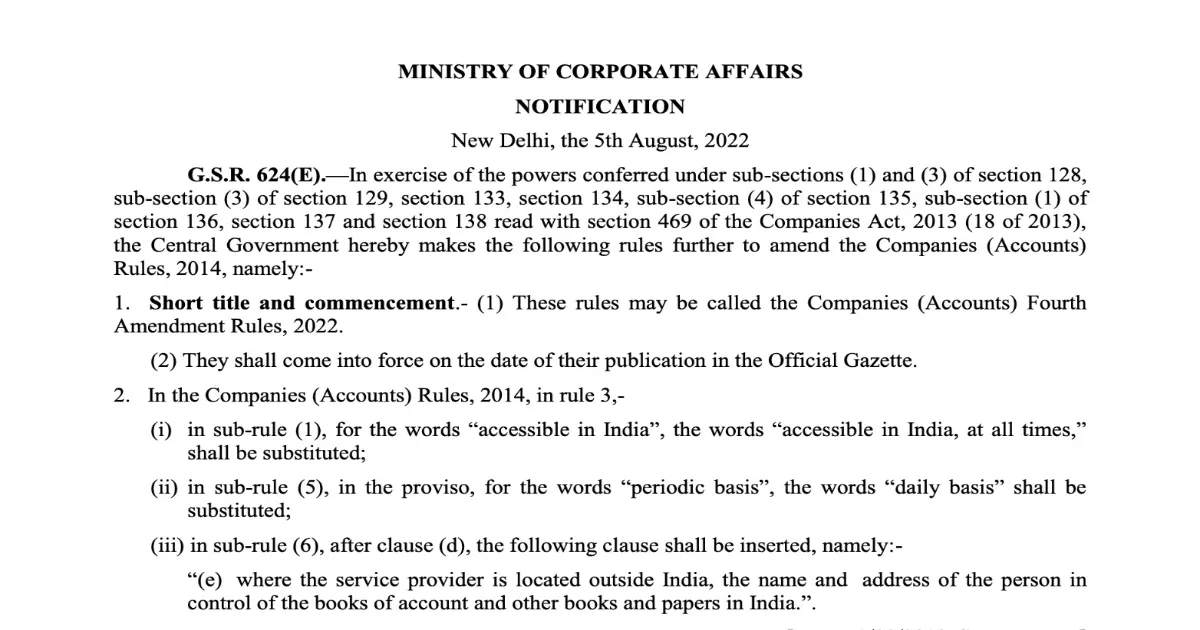
The MCA notification mandating an audit trail (edit log) in accounting software. It applies to companies, including private limited companies, from 1 April 2023.
What Is Bookkeeping for a Startup?
Bookkeeping for a startup is the systematic recording of all financial transactions, such as sales, expenses, payments, and receipts, in a way that gives a true and fair view of the company's finances. It is the foundation every tax filing, board report, and funding round depends on.
For a startup, good bookkeeping does three jobs at once: it keeps you legally compliant, it tells you whether you are actually making money, and it makes you fundable. Investors run due diligence on your books before they wire a rupee, so messy records can cost you a round. Bookkeeping is different from accounting: bookkeeping is the day-to-day recording, while accounting is the broader work of interpreting and reporting on that data. A startup needs both bookkeeping and accounting, which are usually handled together.
Do Startups Legally Need to Do Bookkeeping in India?
Yes. Every company must maintain proper books of accounts from the date of incorporation under Section 128 of the Companies Act 2013. Separately, Section 62 of the Income Tax Act 2025 prescribes book-maintenance requirements for specified professions and for businesses that meet the applicable income or turnover thresholds, and the GST law requires registered persons to keep prescribed records. For a company, the Companies Act obligation applies from incorporation regardless of turnover.
Three separate laws require a startup to keep books, and each carries its own penalty:
- Companies Act 2013 (Section 128): books on the accrual basis and double-entry, kept at the registered office (or another place in India, with a notice filed with the Registrar within 7 days), giving a true and fair view, retained for at least 8 years. Electronic mode is permitted as prescribed.
- Income Tax Act 2025 (Section 62): from 1 April 2026, this replaced the old Section 44AA and requires books for specified professions and for businesses meeting the prescribed income or turnover thresholds.
- GST law (Section 35 of the CGST Act): registered businesses must maintain prescribed accounts and records of supplies, input tax credit, and stock.
Because the obligation starts at incorporation, bookkeeping is not something to defer until you raise money or cross a revenue mark. It begins with your first transaction.
What Changed for Bookkeeping in 2026?
From 1 April 2026, the Income Tax Act 2025 replaced the Income Tax Act 1961, so Section 62 replaced Section 44AA and Rule 46 replaced Rule 6F for maintaining books of accounts. The change is mostly structural, but one new rule matters for every startup on cloud software.
The change is mostly structural: the prescribed records (cash book, journal, ledger, bills, receipts, and registers) remain largely the same, and the "tax year" now replaces the old "previous year," with 2026-27 as the first tax year under the new Act. On the data side, Rule 46(8) of the Income-tax Rules now applies a daily India-server backup standard to all taxpayers. For companies, that same daily-backup requirement has already applied since 2022 under the Companies (Accounts) Rules, so if your startup uses Zoho Books, TallyPrime, QuickBooks, or any cloud or ERP system, it applies to you either way.
For a company, this comes from Rule 3(5) of the Companies (Accounts) Rules, 2014, as amended on 5 August 2022: electronic books must remain accessible in India at all times, and the backup must be kept on servers physically located in India and updated on a daily basis (changed from the earlier periodic basis). The primary server may be outside India, but the daily India-located backup is mandatory. From the tax year starting 1 April 2026, Rule 46(8) of the Income-tax Rules extends the same daily-backup standard to all taxpayers under the Income Tax Act 2025. Startups using cloud accounting software should verify their provider's data-residency and backup arrangements, because this is a legal requirement, not just a best practice.
Is an Audit Trail Mandatory for Private Limited Companies?
Yes. From 1 April 2023, every company that maintains its books in accounting software must use software with an audit trail (edit log) feature that records every transaction, logs each change with its date, and cannot be disabled. This applies to private limited companies; it does not apply to proprietorships, partnership firms, or LLPs.
The requirement comes from a proviso to Rule 3(1) of the Companies (Accounts) Rules, 2014, first notified by the Ministry of Corporate Affairs on 24 March 2021 and, after two deferrals, made effective from 1 April 2023. The goal is to stop back-dated entries and silent edits to the books. In practice, three conditions must be met:
- Record an audit trail of each and every transaction in the books of account.
- Create an edit log of every change, along with the date the change was made.
- The audit trail cannot be disabled, and it must operate throughout the year for all transactions.
There is a compliance sting for startups here: the company's auditor must state in the audit report whether audit-trail software was used and whether the feature operated and was not tampered with throughout the year. So this is not just a software setting, it is something your audit is tested against. Mainstream cloud tools like Zoho Books and TallyPrime provide a compliant, non-disableable edit log, while a basic spreadsheet does not meet this requirement for a company.
What Books of Accounts Must a Startup Maintain?
Depending on the applicable law and the nature of the business, a startup typically maintains records such as cash and bank records, sales and purchase records, journals, ledgers, asset and liability records, and GST and TDS records. For a company, Section 128 requires these to be kept on the accrual basis and preserved for at least 8 years.
| Record | What it captures |
|---|---|
| Cash book | All cash receipts and payments |
| Bank book | All bank transactions, reconciled to statements |
| Sales and purchase registers | All invoices raised and bills received |
| Journal and ledger | Double-entry records grouped by account head |
| GST records | Output tax, input tax credit, and returns |
| TDS records | Tax deducted, deposited, and returns filed |
Companies incorporated under the Companies Act must maintain their books on the accrual basis and according to the double-entry system, recording income when earned and expenses when incurred. This is a requirement of Section 128, not merely a best practice.
How Do You Set Up Bookkeeping for a Startup?
To set up startup bookkeeping, open a dedicated business bank account, choose the accrual method, select cloud accounting software, build a chart of accounts, record transactions consistently, reconcile monthly, and track GST, TDS, and ROC deadlines. Getting the setup right from day one saves months of clean-up.
Here is the sequence most startups should follow:
- Open a dedicated business bank account and route all business money through it, never a personal account.
- Choose the accrual method with double-entry, as required under Section 128 for companies.
- Select cloud accounting software such as Zoho Books or TallyPrime that handles Indian GST and TDS.
- Build a chart of accounts matched to your revenue streams and expense heads.
- Record transactions daily or weekly, attaching each bill or receipt.
- Reconcile the bank monthly so nothing is missed or duplicated.
- Track GST, TDS, and ROC deadlines with a compliance calendar or an outsourced partner.
In our experience with early-stage founders, the single habit that prevents the most pain is never mixing personal and business funds. Open the current account, put every expense through it, and reimburse yourself cleanly. Founders who pay business costs from personal cards and cash spend the most time and money reconstructing books later, often right when an investor asks for them.
What Should Founders See Every Month?
Every month, a founder should get a profit and loss statement, a balance sheet, the cash position, and the numbers that show whether the business is healthy: burn, runway, receivables, payables, and the GST and TDS position. Debits and credits are the bookkeeper's job; these outputs are what a founder actually runs the company on.
Good monthly bookkeeping should hand you a clear picture, not a pile of ledgers. At a minimum, your monthly reporting should tell you:
- Profit and loss: what you earned and spent, and whether you made or lost money.
- Balance sheet: what you own and owe at month end.
- Cash-flow position: how much cash actually moved, and where it went.
- Bank reconciliation: confirmation that the books match every bank account.
- Accounts receivable: who owes you money, and how overdue it is.
- Accounts payable: what you owe suppliers, and when it is due.
- GST position: your output tax, input tax credit, and net GST payable.
- TDS payable: tax deducted that must be deposited.
- Founder and director balances: money moving between you and the company.
- Monthly burn: your net cash outflow for the month.
- Runway: how many months of cash you have left at the current burn.
- Budget versus actual: how the month compared with your plan.
Burn and runway are the two numbers most early founders check first, because they answer the only question that matters when cash is tight: how long do we have. If your bookkeeping does not produce these each month, it is recording history without informing decisions.
Monthly Startup Bookkeeping Checklist
A monthly bookkeeping routine keeps your books accurate and your reports reliable. Work through the same checklist every month so nothing slips and the numbers you rely on are current. This is the rhythm that prevents the year-end scramble.
- Reconcile every bank account against its statement.
- Record all sales invoices raised during the month.
- Record all supplier bills received.
- Upload expense receipts and attach them to each entry.
- Reconcile payment gateways such as Razorpay or Stripe against payouts.
- Reconcile GST: match output tax and input tax credit against GSTR-2B.
- Reconcile TDS deducted and deposited.
- Review receivables and follow up on overdue invoices.
- Review payables and plan upcoming payments.
- Review founder and director transactions for correct treatment.
- Generate the profit and loss and balance sheet for the month.
- Review cash burn and runway against your plan.
Set a fixed date each month, for example the 7th, to close the previous month's books using this checklist. A predictable monthly close is what separates startups that always know their numbers from those that discover problems only at audit or fundraising. Whoever owns your books, in-house or outsourced, should deliver against a checklist like this every month.
What Are the Most Common Startup Bookkeeping Mistakes?
The most common mistakes are mixing personal and business money, letting transactions pile up, ignoring GST and TDS deadlines, not reconciling the bank, and treating bookkeeping as a year-end task. Each is avoidable and each is expensive.
- Mixing funds: paying business expenses from personal accounts makes clean books nearly impossible.
- Piling up transactions: months of unrecorded entries lead to errors and missed input tax credit.
- Missing TDS obligations: failure to deduct attracts interest at 1 percent per month, and failure to deposit after deducting attracts 1.5 percent per month, with non-deposit able to disallow the expense.
- Skipping bank reconciliation: unreconciled books hide errors, duplicates, and cash-flow problems.
- Year-end scramble: leaving everything to the last minute causes rushed, error-prone filings.
Most of these trace back to a founder trying to do books in spare time between building and selling. That is exactly the work an outsourced bookkeeper removes.
Should Startups Outsource Bookkeeping?
Yes, most early-stage startups should outsource bookkeeping, because it gives accurate, compliant, up-to-date books without the cost of hiring, training, and managing a full-time in-house accountant. It lets founders focus on the business.
The decision comes down to cost, quality, and focus. A full-time accountant means a salary plus software, training, and management time, which is hard to justify at low transaction volumes. Outsourced bookkeeping converts that into a predictable monthly cost, handled by people who do GST, TDS, and reporting every day. Just as importantly, it frees the founder's time. In-house bookkeeping usually starts to make sense only at higher volumes or with complex, multi-entity operations. For most founders, outsourced startup bookkeeping is the cleaner path.
| Factor | In-house accountant | Outsourced bookkeeping |
|---|---|---|
| Cost | Salary plus software and training | Predictable monthly fee |
| Compliance depth | Depends on one hire | A team that files daily |
| Founder time | Hiring and managing | Freed to run the business |
| Best for | Higher volumes, complex operations | Early to growth-stage startups |
What Are the Benefits of Outsourcing Startup Bookkeeping?
Outsourcing gives a startup accurate, compliant, investor-ready books without building an in-house finance team, so founders can focus on the business. It combines the right software with people who handle Indian compliance day to day.
The benefits founders value most are:
- Lower, predictable cost: monthly bookkeeping typically costs less than a full-time accountant plus tools.
- Compliance you can trust: GST, TDS, and ROC handled by people who do it every day, reducing notices and penalties.
- Always-current books: regular recording and reconciliation, not a year-end rush.
- Investor-ready from the start: clean books and clear reports when you raise funds or run due diligence.
- Scales with the business: the same partner can support you from incorporation through growth, adding Virtual CFO and accounts payable support as volumes rise.
Whoever keeps your books, the test is the same: accurate records, a monthly close, and clean compliance. IncorpX provides startup bookkeeping on that basis, set up correctly and kept current on software like Zoho Books.
Summary
For an Indian startup, bookkeeping is a legal obligation from day one under Section 128 of the Companies Act 2013, with Section 62 of the Income Tax Act 2025 adding threshold-based requirements from 1 April 2026 and the Companies (Accounts) Rules requiring a daily India-server backup of electronic books since 2022. Keep the core books on the accrual basis, separate business and personal money, record consistently, reconcile monthly, and stay ahead of GST, TDS, and ROC deadlines. Poor books can be costly, through penalties, delayed due diligence, clean-up costs, and investor concerns, usually far more than good bookkeeping costs to maintain. For many startups, outsourcing bookkeeping is a cost-effective way to keep records accurate and compliance current. If you would like IncorpX to set up and run your startup's bookkeeping, listed amounts are IncorpX professional charges for end-to-end assistance, and government or statutory fees are charged separately at actuals.
Frequently Asked Questions
Do startups need to maintain books of accounts in India?
When should a startup start bookkeeping?
What books of accounts must a startup maintain?
How much does bookkeeping cost for a startup in India?
Should a startup do bookkeeping in-house or outsource it?
What is the new Income Tax Act 2025 rule for books of accounts?
Which accounting software is best for Indian startups?
Do startups need to file GST if registered?
What happens if a startup does not maintain proper books?
Is bookkeeping the same as accounting?
Who is responsible for a startup's books of accounts?
Is an audit trail mandatory for private limited companies?
How often should a startup update its books?
Need Help With This Process?
Our experts are ready to assist you every step of the way. Get started with a free consultation today!