How to Get Startup Tax Exemption in India in 2026
How to get the 3-year startup tax exemption in India: get DPIIT recognition, then apply under Section 80-IAC and pass Inter-Ministerial Board review to qualify.


Documents Required
- Certificate of incorporation of the Private Limited Company or LLP
- DPIIT recognition certificate (current and not revoked)
- PAN of the entity
- Memorandum of Association and Articles of Association for a company, or the LLP agreement for an LLP
- Board resolution authorising the application, if applicable
- Balance sheet and profit and loss account for the last 3 financial years, or since incorporation, certified by a practicing compliance professional
- Income tax returns for the past 3 years, or from incorporation if the startup is younger
- Pitch deck of maximum 5 slides covering the problem, solution, technology, market, business model, traction and team
- A short video pitch describing the startup
- A write-up on the innovation explaining what makes the business different and hard to replicate, with details of employees and any funds raised
Tools & Prerequisites
- Registered account on the Startup India portal at startupindia.gov.in
- Valid DPIIT recognition as a startup
- Entity incorporated as a Private Limited Company or Limited Liability Partnership (LLP)
- PAN and login credentials for the entity on the portal
- PDF or JPG scanner or app to prepare document attachments
If you want to know how to get the startup tax exemption in India, here is the short answer: you get DPIIT recognition first, then you apply separately under Section 80-IAC, and an official board reviews your application before granting the 3-year tax holiday. The part that catches most founders off guard is that the DPIIT certificate by itself does not give you any tax exemption. We hear this confusion often. One client asked us just yesterday why he still has to pay GST when he holds a DPIIT certificate. This guide answers both questions in plain terms: how the exemption actually works, and why holding a Startup India certificate does not, on its own, mean you pay no tax.
The clearest way to see this is to look at the two documents themselves. They are separate certificates, issued at different stages. The first is the DPIIT Certificate of Recognition, which simply confirms you are a recognised startup. The second is the Certificate of Eligible Business under Section 80-IAC, issued only after the Inter-Ministerial Board approves your application, and this is the one that actually grants the tax exemption.
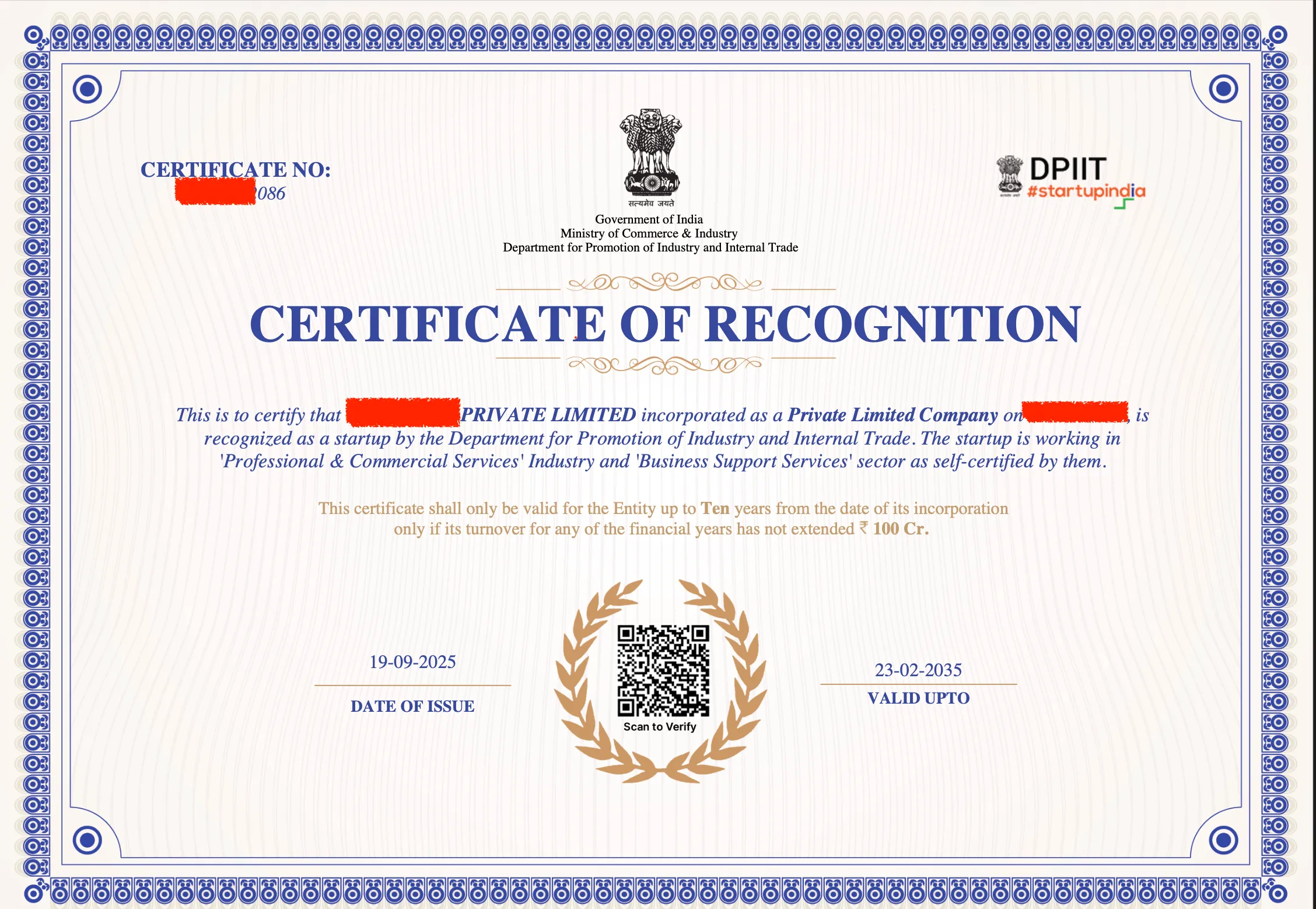
Step 1: The DPIIT Certificate of Recognition confirms your startup status. It does not by itself grant any tax exemption.
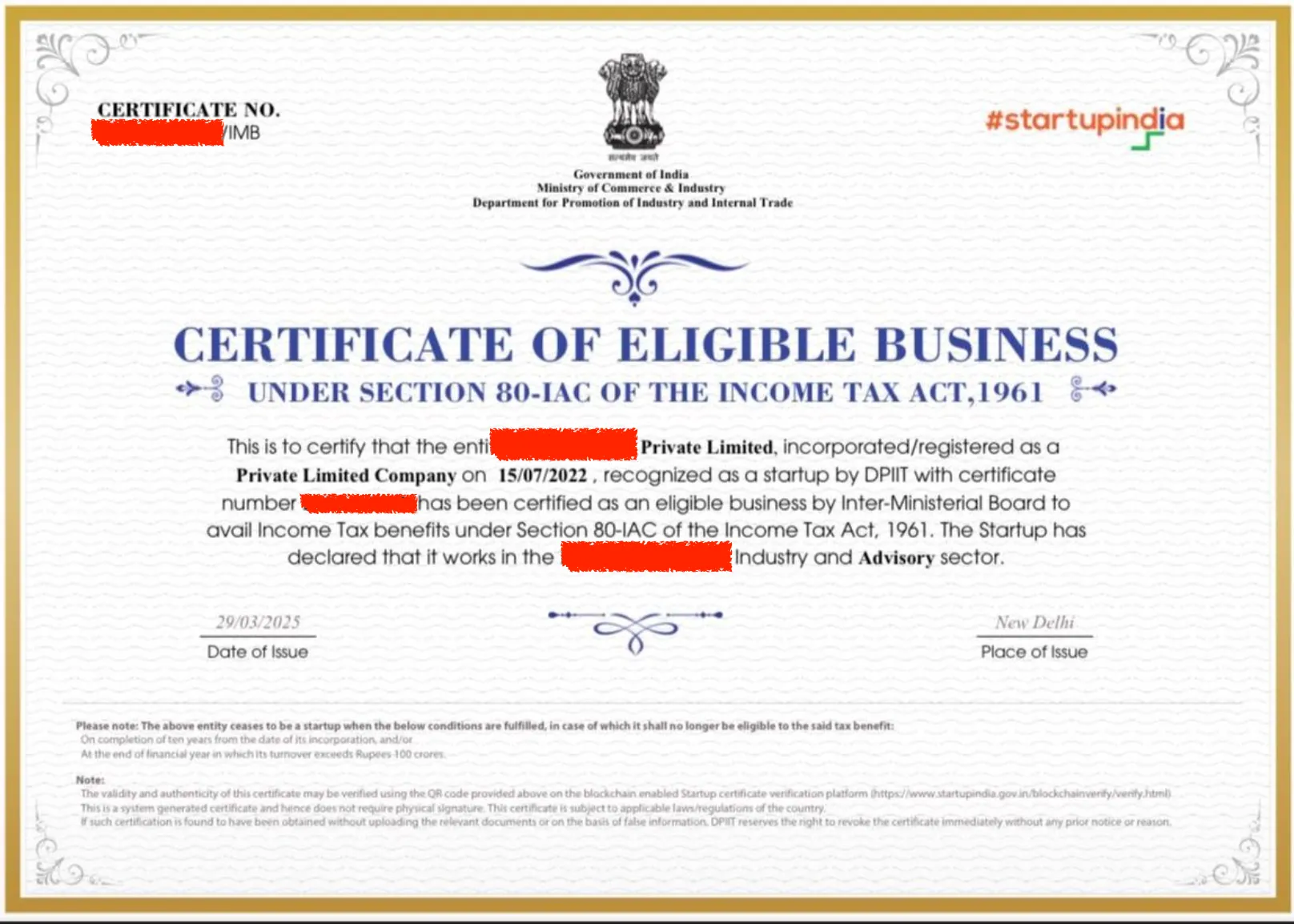
Step 2: The Certificate of Eligible Business under Section 80-IAC, issued after IMB approval. This is the certificate that grants the 3-year income tax holiday.
How Do I Get the Startup Tax Exemption?
You get the startup tax exemption by first obtaining DPIIT recognition and then applying separately under Section 80-IAC, which the Inter-Ministerial Board reviews before approval. There is no single button that grants a tax holiday. It is a two-step process, and both steps are separate applications.
- Step 1: Get DPIIT recognition. Register your Private Limited Company or LLP on the Startup India portal and obtain DPIIT recognition. This is free, usually granted within 72 hours, and it is the mandatory foundation. But it only makes you eligible to apply for the tax holiday.
- Step 2: Apply for Section 80-IAC. As a DPIIT-recognised startup, file Form 80IAC on the same portal. This application goes to the Inter-Ministerial Board, which reviews your business on its merits. If approved, you receive a certificate that lets you claim a 100 percent income tax exemption on eligible business profits for any 3 consecutive years out of your first 10.
The gap between these two steps is where the confusion lives. Getting DPIIT recognition feels like the finish line, but it is really just the entry ticket. The actual exemption is decided in Step 2, and not every applicant clears it.
Why Do I Still Pay GST If I Have a DPIIT Certificate?
Because GST and the startup tax holiday are two completely different taxes, and DPIIT recognition affects neither of them automatically. This is the exact question our client asked, so it is worth being very clear.
GST is an indirect tax on the goods and services you sell. You charge it to your customers, collect it, and pass it to the government, and you file GST returns regardless of your profits. Section 80-IAC is a benefit against income tax, which is a tax on your profits. These are separate systems under separate laws.
DPIIT recognition does not exempt you from GST. It never has. Even a startup that has obtained the full 80-IAC income tax holiday still charges GST, still collects it, still pays it, and still files GST returns on time. If your turnover crosses the GST threshold for your activity, you register for GST and comply, DPIIT certificate or not. So if you are paying GST despite holding a DPIIT certificate, nothing has gone wrong. That is simply how the system works.
What Does a DPIIT Certificate Give Me?
DPIIT recognition, also called Startup India registration, is the government's official certificate that your entity qualifies as a startup. It is free, usually granted within about 72 hours, and genuinely valuable. But its value is a bundle of benefits that mostly reduce friction, not a blanket tax exemption.
Here is what DPIIT recognition actually gives you, and what it does not.
| Founder Assumption | Reality |
|---|---|
| "I get a 3-year income tax holiday" | No. Only eligibility to apply for it under 80-IAC, granted separately by the IMB |
| "I am exempt from GST" | No. GST applies normally, regardless of DPIIT or 80-IAC status |
| "I get patent and trademark discounts" | Yes. 80% patent fee rebate and 50% trademark discount |
| "I get angel tax protection" | Yes. Under Section 56(2)(viib), with DPIIT recognition and a declaration |
| "I can self-certify under labour laws" | Yes. Self-certification under several labour and environmental laws |
| "I get government procurement access" | Yes. Through the GeM portal with relaxed norms |
The two things founders most often assume they are getting, an automatic income tax holiday and GST relief, are exactly the two things the DPIIT certificate does not include by itself.
What Is the Section 80-IAC Tax Exemption?
Section 80-IAC gives an eligible startup a 100 percent deduction on the profits of its eligible business for any 3 consecutive financial years, chosen from the first 10 years since incorporation. This is the actual "3-year tax holiday" people mean when they talk about startup tax benefits.
The mechanics are worth understanding:
- The deduction is 100 percent of eligible-business profits, so for those three years you can legally pay zero income tax on that profit.
- You choose any 3 consecutive years out of the first 10 since incorporation, which lets you pick your most profitable window.
- It applies only to eligible-business profit, not to unrelated income like interest or rent.
- Most startups make losses in their early years, so the freedom to choose the years is what makes the benefit valuable once you turn profitable.
To put a number on it: a startup earning ₹3 crore of annual eligible-business profit could save on the order of ₹90 lakh to over ₹1 crore across the three years, depending on the applicable surcharge. That is a serious benefit, which is exactly why the government does not hand it out automatically.
What Is the Difference Between DPIIT and 80-IAC?
The cleanest way to fix the misconception is to see the two side by side.
| Feature | DPIIT Recognition | Section 80-IAC Exemption |
|---|---|---|
| What it is | Certificate that you are a recognised startup | 100% income tax deduction on profits for 3 years |
| Who grants it | DPIIT, via the Startup India portal | Inter-Ministerial Board (IMB) after review |
| How long it takes | About 72 hours | Up to 120 days, often several months |
| Is it automatic? | Granted on meeting basic criteria | No. Substantive review of innovation and scalability |
| Cost | Free (₹0 government fee) | Free to apply, but rigorous to clear |
| Does it affect GST? | No | No |
| Approval rate | High for eligible entities | Roughly 1.8% of DPIIT startups hold it |
DPIIT recognition is necessary but not sufficient. It is the door you walk through first, but the 80-IAC holiday is a second, much stricter door on the other side.
Do I Still Have to Pay Any Tax During the Exemption?
Even with the 80-IAC exemption, a Private Limited Company still pays Minimum Alternate Tax (MAT) at 15 percent of its book profits under Section 115JB. This surprises many founders. The 80-IAC holiday removes your normal income tax, but it does not remove your minimum tax, so a profitable startup in its holiday years usually still writes a cheque to the tax department.
Here is how it actually works, and it matters for your cash flow:
- During the 3 holiday years, your normal income tax on eligible profits is nil, thanks to the 100 percent deduction.
- But MAT at 15 percent of book profits (plus surcharge and cess) still applies to companies, so there is a real tax outflow.
- The MAT you pay is not lost. It becomes a MAT credit under Section 115JAA that you can carry forward for up to 15 assessment years.
- You set off that credit in later years, once your normal tax exceeds your MAT. In effect, MAT during the holiday is more of a deferred payment than a permanent cost.
Is an LLP or a Private Limited Company Better for Tax?
This is where your choice of structure has a genuine tax consequence that many guides miss. LLPs are not subject to MAT. An LLP claiming 80-IAC instead pays Alternate Minimum Tax (AMT) under Section 115JC, but the practical outcome differs:
- A Private Limited Company pays 15 percent MAT on book profits during the holiday, so it does not reach a truly zero-tax position.
- An LLP, being outside MAT, can reach a genuinely cleaner tax outcome on qualifying business profits during the exemption period (AMT applies on adjusted total income, which for a pure eligible-business LLP with the 80-IAC deduction can be far lower).
This does not automatically make an LLP the better choice, because a Private Limited Company is usually far better for raising equity funding. But if a clean tax position during the holiday matters more to you than fundraising, it is a trade-off worth modelling before you incorporate.
Who Is Eligible for the 80-IAC Exemption?
Before the IMB even looks at your innovation, your startup has to clear a set of hard eligibility conditions. Every one must be met. Missing one means rejection.
- The startup must be a Private Limited Company or an LLP. One Person Companies, sole proprietorships, and partnership firms do not qualify for 80-IAC, even though a partnership firm can get DPIIT recognition.
- The startup must be DPIIT-recognised.
- It must be incorporated between 1 April 2016 and 31 March 2030 (the deadline was extended to 2030 in Budget 2025-26).
- Annual turnover must not exceed ₹100 crore in the year the deduction is claimed.
- The startup must not be formed by splitting or reconstructing an existing business.
What Else Can Disqualify My Startup From 80-IAC?
Beyond the headline eligibility rules, Section 80-IAC has two anti-abuse conditions that trip up otherwise-eligible startups. These exist to make sure the benefit goes to genuinely new ventures, not repackaged old ones.
Can I Use Old Plant and Machinery in My Startup?
Your startup must not be formed by transferring plant and machinery already in use. There are two practical exceptions:
- The 20 percent rule: using some previously-used plant and machinery is allowed, as long as its value does not exceed 20 percent of the total value of the plant and machinery used in the business.
- Imported second-hand machinery: imported plant and machinery is treated as new, provided it was not used in India before, and no depreciation was claimed on it in India by anyone before you installed it.
Can I Claim 80-IAC If I Restructured an Old Business?
Your startup must not be formed by splitting up or reconstructing an existing business. The main exception is Section 33B of the Income Tax Act, which allows a reconstructed business to still claim 80-IAC if it was discontinued because of damage or destruction from a natural calamity, riots or civil disturbance, accidental fire or explosion, or an act of the enemy, and is then re-established within the permitted time.
How Does the Inter-Ministerial Board Review My Application?
This is the part that surprises founders. Once you meet the eligibility conditions, you file Form 80IAC on the Startup India portal, and it goes to the Inter-Ministerial Board for a genuine, substantive review. The IMB is not ticking boxes. It is deciding whether your startup deserves to pay zero tax, and it applies a stricter standard than most founders expect.
What Does the IMB Look For?
The legal test is whether the startup is "working towards innovation, development or improvement of products, processes or services, or has a scalable business model with a high potential of employment generation or wealth creation." In practice, the IMB weighs:
- Innovation: what is genuinely new or different about your product, process, or service
- Scalability: whether the business model can grow meaningfully, not just operate
- Employment generation: the number of jobs you have created and will create
- Wealth creation: the measurable economic value the startup produces
- Evidence the product is real and operational, not just an idea on paper
What Documents Do I Need to Submit?
Your application is judged largely on the documents you provide. The core ones are:
- A pitch deck (maximum 5 slides) covering the problem, your solution, the technology behind it, market size, business model, traction, and the founding team
- A write-up on the innovation, explaining what makes the business different and hard to replicate
- Balance sheet and profit and loss account for the last 3 financial years (or since incorporation), certified by a practicing compliance professional
- Income tax returns for the past 3 years, or from incorporation if the startup is younger
- Financial projections, along with the number of employees and any funds raised
- A short video pitch describing the startup (commonly requested)
- Certificate of incorporation, PAN, DPIIT recognition certificate, the MOA and AOA (for a company) or LLP agreement, and a board resolution if applicable
Why Do 80-IAC Applications Get Rejected?
With only around 1.8 percent of DPIIT startups holding the exemption, it helps to know why applications get turned down. The recurring reasons are all avoidable:
- The startup is not clearly innovative. Pure trading, reselling, or a standard service business without real differentiation rarely clears the bar.
- Weak documentation. A vague pitch deck or video that does not explain the idea clearly, or missing documents.
- Unrealistic financial projections not supported by any evidence.
- Slow or incomplete responses when the IMB asks follow-up questions.
- Basic eligibility not met, most often an incorporation date before 1 April 2016.
The pattern is clear. The startups that succeed treat the application as a serious case to be argued with evidence, not a form to be filled.
How Can I Improve My Chances of Approval?
If you want the 3-year tax holiday, here is the honest sequence to follow.
- Get DPIIT recognition first. It is free, fast, and mandatory before you can apply for 80-IAC. It also unlocks the patent, trademark, and angel tax benefits regardless of what happens with 80-IAC.
- Do an honest eligibility check. Confirm your structure (Private Limited or LLP), incorporation date, and turnover. If you fail the basics, do not waste an application.
- Build a real case for the IMB. A focused pitch deck, a clear innovation write-up, credible financials, and evidence your product works.
- Apply as soon as you show early profitability, not at year-end. The review can take months.
- Mind the 115BAA trap. Do not opt into the concessional 22 percent tax rate if you intend to claim 80-IAC, because you cannot have both, and the choice is irreversible.
- Keep complying with GST and your other filings throughout. The tax holiday, if granted, applies only to income tax on eligible profits, nothing else.
Conclusion
So, how do you get the startup tax exemption? You get DPIIT recognition first, then you apply separately under Section 80-IAC, and the Inter-Ministerial Board decides whether your startup qualifies for the 3-year, 100 percent income tax holiday. The DPIIT certificate on its own does not give you the exemption, and it does not touch your GST obligations at all. Roughly 1.8 percent of DPIIT startups actually hold the 80-IAC exemption, which tells you how seriously the review is taken.
If you are paying GST despite holding a DPIIT certificate, nothing has gone wrong, because that is not what the certificate does. And if you want the real tax holiday, the path is clear: get recognised, confirm your eligibility, and put together a genuine, evidence-backed case for 80-IAC.
IncorpX provides end-to-end support for Startup India DPIIT recognition and Section 80-IAC filing, from an honest eligibility assessment to drafting the innovation narrative, preparing the pitch deck, and managing the IMB application, alongside GST registration and ongoing compliance. Government portal fees for DPIIT recognition are ₹0, and our professional charges are separate and billed at actuals. If you are unsure whether your startup qualifies, a free eligibility check is the sensible first step before you apply.
Frequently Asked Questions
How do I get tax exemption for my startup in India?
Does a DPIIT certificate give me a 3-year tax exemption?
Why do I still have to pay GST if I have a DPIIT certificate?
What is the difference between DPIIT recognition and 80-IAC?
What does the 80-IAC tax exemption actually give me?
Who reviews the 80-IAC application?
What decides whether my 80-IAC application is approved?
Which entities are eligible for 80-IAC?
Until when can a startup be incorporated to qualify for 80-IAC?
Can a startup claim both 80-IAC and the concessional 115BAA tax rate?
Is the 80-IAC exemption available on all my income?
How long does the IMB take to decide?
Do I still pay tax during the 80-IAC holiday because of MAT?
Is an LLP or a Private Limited Company better for the 80-IAC exemption?
What documents do I need to apply for 80-IAC?
What is angel tax exemption and is it the same as 80-IAC?
Need Help With This Process?
Our experts are ready to assist you every step of the way. Get started with a free consultation today!











 Ashwin Raghu
