Manufacturing Company Registration in India
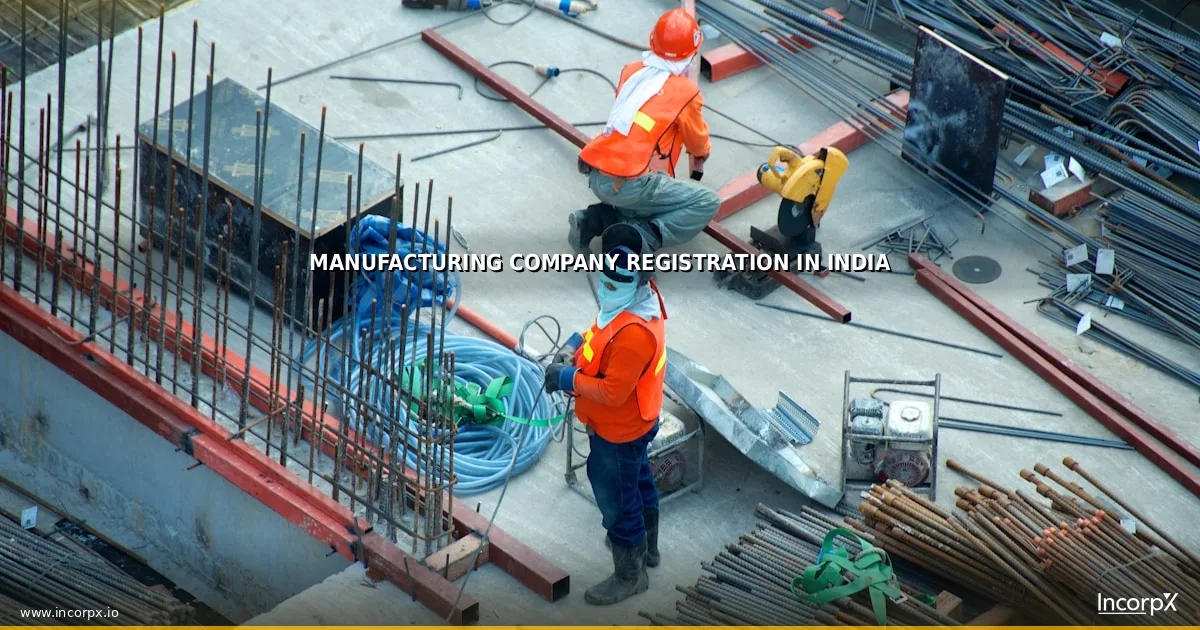
Why Manufacturing Needs Careful Registration Planning
Manufacturing is India's second-largest GDP contributor at 17%, and the government's vision of a $1 trillion manufacturing economy by 2030 has created unprecedented incentives. However, manufacturing businesses face the most complex regulatory landscape of any sector: factory licences, environmental clearances, labour law compliance, product certifications, and multi-layer tax compliance.
A properly registered manufacturing company can access: 15% corporate tax rate under Section 115BAB (lowest in India's history), PLI incentives worth 4% to 10% of production, MSME priority lending, and subsidised industrial land. But accessing these benefits requires getting the registration sequence right from day one.
Step-by-Step Manufacturing Company Registration
Step 1: Company Incorporation (3 to 7 Working Days)
Register as a Private Limited Company through SPICe+ with NIC code matching your manufacturing activity (e.g., 10 for food, 20 for chemicals, 26 for electronics). For Section 115BAB tax benefits, the company must be incorporated after 1st October 2019 and commence manufacturing before 31st March 2024 (extended deadlines apply).
Step 2: MSME/Udyam Registration (Same Day)
Register at udyamregistration.gov.in for free. This unlocks priority sector lending, delayed payment protection, and government scheme eligibility. Classification is based on investment in plant and machinery + annual turnover.
Step 3: Industrial Land/Premises (30 to 90 Days)
Acquire industrial land through state industrial development corporations:
| State | Industrial Body | Land Cost per sq. m | Key Industrial Areas |
|---|---|---|---|
| Maharashtra | MIDC | ₹2,000 to ₹15,000 | Pune, Aurangabad, Nashik |
| Gujarat | GIDC | ₹1,500 to ₹10,000 | Ahmedabad, Surat, Rajkot |
| Tamil Nadu | SIPCOT | ₹1,000 to ₹8,000 | Chennai, Coimbatore, Hosur |
| Karnataka | KIADB | ₹2,000 to ₹12,000 | Bengaluru, Mysuru, Hubballi |
| Rajasthan | RIICO | ₹500 to ₹5,000 | Jaipur, Bhiwadi, Neemrana |
| Uttar Pradesh | UPSIDA | ₹500 to ₹4,000 | Noida, Greater Noida, Agra |
Step 4: Environmental Clearances (30 to 120 Days)
Apply to the State Pollution Control Board (SPCB) for:
- Consent to Establish (CTE): Before constructing the factory. Requires: site plan, process flow, emission estimates, waste management plan
- Environmental Clearance: For projects exceeding threshold limits under EIA Notification, 2006. Involves public hearing for Category A projects
- Hazardous Waste Authorization: If generating hazardous waste (mandatory for chemical, pharmaceutical, and electronics manufacturing)
Step 5: Factory Licence (30 to 60 Days)
Apply under the Factories Act, 1948 through the state's online portal. The Factory Inspector visits the premises to verify: building plan compliance, machinery safety, worker welfare facilities (drinking water, toilets, rest rooms), fire safety equipment, and ventilation/lighting standards.
Step 6: GST and Tax Registrations
Apply for GST registration with proper HSN codes for your manufactured products. For Section 115BAB benefits, file Form 10-ID with the Income Tax return opting for the 15% tax regime (irrevocable once chosen).
Step 7: Product Certifications
Obtain mandatory certifications based on your product:
- BIS ISI Mark: For products under compulsory certification (electrical items, steel, cement, water bottles)
- FSSAI Registration: For food manufacturing (₹100 to ₹7,500 depending on scale)
- CDSCO Approval: For pharmaceutical and medical device manufacturing
- PESO Licence: For petroleum and explosives storage
- ISO Certification: Voluntary but expected by corporate buyers (ISO 9001, ISO 14001)
Labour Compliance for Manufacturing
Manufacturing companies have the highest labour compliance burden of any sector:
| Compliance | Threshold | Key Requirements | Penalty |
|---|---|---|---|
| EPF Registration | 20+ employees | 12% employer + 12% employee contribution | 12% to 100% interest + prosecution |
| ESIC Registration | 10+ employees (state-specific) | 3.25% employer + 0.75% employee | ₹5,000 + imprisonment |
| Minimum Wages | All employees | State-specific rates, revised biannually | ₹50,000 fine + imprisonment |
| Payment of Bonus | 20+ employees | Minimum 8.33%, maximum 20% of salary | ₹1,000 to ₹5,000 + imprisonment |
| Payment of Gratuity | 10+ employees | 15 days salary per year after 5 years | ₹10,000 + imprisonment |
| Contract Labour | 20+ contract workers | Registration + licence for contractors | ₹10,000 + imprisonment |
| Safety Officer | 1,000+ workers | Qualified Safety Officer on rolls | Prosecution under Factories Act |
Tax Benefits for New Manufacturing Companies
Manufacturing companies enjoy significant tax advantages in India:
Section 115BAB: 15% Corporate Tax
New manufacturing companies can opt for a flat 15% corporate tax rate (effective rate ~17.16% with surcharge and cess). Conditions:
- Company incorporated on or after 1st October 2019
- Manufacturing commenced before 31st March 2024 (check latest extensions)
- Not availing any other tax exemption (deductions under Section 10AA, 32, 33AB, 35, 80-IA to 80-IBA, etc.)
- Option exercised via Form 10-ID (irrevocable)
Additional Tax Benefits
- Accelerated depreciation: Plant and machinery eligible for 15% to 40% depreciation (Written Down Value method)
- Investment allowance: Additional 15% deduction on new plant and machinery costing ₹25 crore+ (for non-115BAB companies)
- Export benefits: Zero-rated GST on exports, duty drawback, MEIS/RoDTEP scheme benefits
- State incentives: Stamp duty waiver, electricity subsidy, capital subsidy varying by state
Annual Compliance Calendar
| Compliance | Frequency | Authority | Deadline |
|---|---|---|---|
| Factory Licence Renewal | Annual | Factory Inspector | Before expiry date |
| Pollution CTO Renewal | Annual/5-yearly | SPCB | 3 months before expiry |
| Factory Annual Return | Annual | Factory Inspector | 31st January |
| GST Returns (GSTR-1/3B) | Monthly | GST Department | 11th/20th of next month |
| EPF/ESIC Contributions | Monthly | EPFO/ESIC | 15th of next month |
| TDS Returns | Quarterly | IT Department | End of month after quarter |
| AOC-4/MGT-7 | Annual | ROC/MCA | Within 30/60 days of AGM |
| Income Tax Return | Annual | IT Department | 31st October |
| Hazardous Waste Return | Annual | SPCB | 30th June |
Government Schemes for Manufacturing Companies
India offers multiple financial incentives specifically for manufacturers. Here is a comprehensive overview of key schemes available in 2026:
Production Linked Incentive (PLI) Scheme
The PLI scheme covers 14 sectors with a total outlay of ₹1.97 lakh crore. Incentives are calculated as a percentage of incremental sales over the base year:
| Sector | Incentive Rate | Minimum Investment | Incentive Period |
|---|---|---|---|
| Mobile and Electronics | 4% to 6% | ₹250 crore to ₹1,000 crore | 5 years |
| Pharmaceuticals | 3% to 10% | ₹50 crore to ₹200 crore | 6 years |
| Food Processing | 4% to 10% | ₹10 crore (MSME) | 6 years |
| Textiles | 7% to 11% | ₹300 crore | 5 years |
| Auto and Components | 13% to 18% | ₹250 crore to ₹500 crore | 5 years |
| White Goods (AC/LED) | 4% to 6% | ₹7 crore to ₹25 crore | 5 years |
Additional Government Schemes
- CLCSS (Credit Linked Capital Subsidy Scheme): 15% capital subsidy on plant and machinery for MSMEs upgrading technology (maximum subsidy ₹15 lakh)
- SFURTI: Scheme of Fund for Regeneration of Traditional Industries, providing up to ₹5 crore per cluster
- ASPIRE: Scheme for Promotion of Innovation, Rural Industries and Entrepreneurship (incubation support)
- ZED Certification: Zero Defect Zero Effect certification for quality and environmental compliance, with subsidised assessment
- Technology Centre Systems Programme: Free access to manufacturing technology centres (18 centres across India)
Environmental and Safety Compliance Framework
Manufacturing units face stringent environmental and safety regulations. Understanding the complete compliance framework prevents costly shutdowns and penalties:
Pollution Category Classification
| Category | Industries | CTE/CTO Requirements | Monitoring Frequency |
|---|---|---|---|
| Red | Chemicals, pharmaceuticals, dyes, tanneries, distilleries | Detailed EIA, public hearing, strict conditions | Monthly stack/effluent monitoring |
| Orange | Food processing, auto parts, textiles (small), engineering | Standard CTE/CTO with conditions | Quarterly monitoring |
| Green | Assembly units, packaging, electronics (small), woodwork | Simplified CTE/CTO | Half-yearly monitoring |
| White | Handloom, cotton ginning, biscuit (small), dhoop making | Self-declaration sufficient | Annual self-monitoring |
Fire Safety Requirements
All manufacturing units must comply with the National Building Code (NBC) 2016 Part 4 on fire and life safety:
- Fire NOC from the Fire Department: Required before occupancy, renewed annually
- Fire extinguishers: One per 200 sq. ft. of factory area, CO2 type near electrical equipment
- Fire hydrant system: Mandatory for factories above 1,500 sq. m built-up area
- Emergency exit routes: Minimum two exits, clearly marked with illuminated signs
- Fire drills: Conducted quarterly with documented attendance records
Occupational Health Standards
The Factories Act mandates specific health measures depending on the manufacturing process:
- Hazardous process disclosure: Annual medical examination for workers in scheduled hazardous processes
- Noise control: Maximum 90 dB(A) for 8-hour exposure (hearing protection mandatory above this)
- Dust control: Regular air quality monitoring, exhaust ventilation for dusty processes
- Chemical safety: Material Safety Data Sheets (MSDS), proper labelling, and spill containment
- Creche facility: Mandatory for factories employing 30+ women workers
Manufacturing Registration: State Comparison
Different states offer varying levels of incentives, infrastructure, and ease of doing business for manufacturing:
| Factor | Maharashtra | Gujarat | Tamil Nadu | Karnataka | Uttar Pradesh |
|---|---|---|---|---|---|
| Land Cost | High | Medium | Medium | High | Low |
| Power Cost/Unit | ₹8 to ₹10 | ₹5 to ₹7 | ₹6 to ₹8 | ₹7 to ₹9 | ₹5 to ₹7 |
| Labour Cost | High | Medium | Medium | Medium | Low |
| Port Access | Excellent (JNPT) | Excellent (Mundra) | Excellent (Chennai) | Good (Mangalore) | Poor (landlocked) |
| EODB Rank | 2nd | 1st | 5th | 3rd | 4th |
| Stamp Duty Waiver | Yes (MIDC areas) | Yes (GIDC areas) | Partial | Yes | Yes (new units) |
| Capital Subsidy | Up to 25% | Up to 12% | Up to 30% | Up to 25% | Up to 15% |
Register your manufacturing Pvt Ltd with IncorpX and get guidance on choosing the best state for your specific industry.
Common Mistakes in Manufacturing Company Registration
Based on IncorpX's experience with 2,000+ manufacturing registrations, these are the most frequent errors:
- Wrong NIC code selection: Choosing a generic code instead of the specific manufacturing sub-category. This affects MSME classification, PLI eligibility, and GST rate applicability
- Skipping environmental clearances: Starting construction before obtaining CTE. The SPCB can order demolition of unauthorised structures and impose fines up to ₹1 lakh per day
- Ignoring factory licence timelines: Factory Inspector visits take 30 to 60 days. Not factoring this into project timelines delays production start
- Incomplete worker documentation: Not maintaining attendance registers, overtime records, or leave records from day one. These are checked during factory inspections
- Missing product certifications: Manufacturing and selling BIS-regulated products without ISI mark attracts product seizure and criminal prosecution
- Not opting for Section 115BAB on time: The option must be exercised with the first income tax return. Missing this means paying 25% tax instead of 15%
- Inadequate insurance coverage: Public Liability Insurance is mandatory for hazardous processes. Operating without it is a criminal offence
How IncorpX Helps Manufacturers
IncorpX provides end-to-end registration support for manufacturing companies:
- Company Registration: Pvt Ltd incorporation with correct manufacturing NIC codes
- MSME Registration: Free Udyam certificate for government scheme eligibility
- GST Registration: Multi-HSN code setup for manufactured products
- Factory Licence Assistance: Documentation and coordination with Factory Inspector
- Annual Compliance: ROC filings, GST returns, factory returns, and pollution compliance
Contact IncorpX to register your manufacturing company today.
Manufacturing Sector Wise Registration Requirements
Each manufacturing sector has unique registration requirements beyond the common ones. Here is a sector-specific overview:
Food Manufacturing
Food manufacturers must obtain FSSAI Central Licence (annual turnover above ₹12 crore) or State Licence (₹12 lakh to ₹12 crore). Additional requirements include: BIS certification for packaged drinking water, AGMARK for agricultural products, organic certification from NPOP-accredited bodies, and export registration certificate from APEDA for food exports. All food manufacturing premises must pass the Food Safety Officer inspection covering hygienic conditions, pest control, water quality, and worker health certificates.
Pharmaceutical Manufacturing
Pharma units need: Drug Manufacturing Licence from CDSCO/State Drug Controller (Form 25/25-A under Drugs and Cosmetics Act, 1940), Schedule M compliance (GMP standards), WHO-GMP certification for exports, Drug Import Licence for raw materials (Active Pharmaceutical Ingredients), and stability testing lab setup. Timeline: 6 to 12 months from application to production start.
Electronics Manufacturing
Electronics manufacturers must comply with: BIS compulsory registration for 52 product categories under Electronics and IT Goods (CRO) Order, E-waste Authorisation from CPCB (as producer), RoHS compliance (Restriction of Hazardous Substances in Electrical Equipment), and BEE star rating (for energy-consuming appliances). PLI scheme for electronics offers 4% to 6% incentive on incremental production.
Chemical Manufacturing
Chemical manufacturers face the strictest environmental compliance: HAZAN (Hazard Analysis) study before commencement, on-site and off-site emergency plans, MSIHC Rules, 1989 compliance (Manufacture, Storage and Import of Hazardous Chemical Rules), GPCB/MPCB specific conditions for effluent treatment, and mandatory Safety Audit by competent persons annually.
Textile Manufacturing
Textile units require: pollution NOC (Orange/Red category for dyeing and bleaching), ZLD (Zero Liquid Discharge) compliance for processing units in certain states, OEKO-TEX or GOTS certification for export markets, and compliance with Hazardous and Other Wastes (Management and Transboundary Movement) Rules for chemical-intensive processes.
Digital Tools for Manufacturing Compliance
Modern manufacturing businesses can streamline compliance using these government digital platforms:
- Shram Suvidha Portal (shramsuvidha.gov.in): Single window for EPF, ESIC, and labour law compliance. Enables self-certification for small factories
- Parivesh Portal (parivesh.nic.in): Online environmental clearance and pollution NOC applications. Track CTE/CTO status in real-time
- National Single Window System (nsws.gov.in): Combined platform for 250+ central and state approvals. Manufacturing units can apply for all licences through one portal
- Udyam Registration Portal (udyamregistration.gov.in): Instant MSME certificate with Aadhaar verification. Free of cost and paperless
- GST Portal (gst.gov.in): GST registration, return filing, e-way bill generation, and ITC reconciliation for manufacturers
- MCA21 V3 Portal: Company incorporation via SPICe+ form, annual filing, and director KYC. All company compliance managed digitally
IncorpX integrates with all these platforms to provide seamless registration and compliance management for your manufacturing company. Get started with IncorpX today.
Manufacturing Company Registration Cost Breakdown
Here is a detailed cost breakdown for registering a manufacturing company in India in 2026:
| Registration Component | Government Fee | Professional Fee | Timeline |
|---|---|---|---|
| Pvt Ltd Company Incorporation | ₹500 to ₹3,000 | ₹5,000 to ₹10,000 | 3 to 7 days |
| Udyam/MSME Registration | Free | Free (self-service) | Same day |
| GST Registration | Free | ₹2,000 to ₹5,000 | 3 to 7 days |
| Factory Licence | ₹1,500 to ₹50,000 | ₹5,000 to ₹15,000 | 30 to 60 days |
| Pollution NOC (CTE + CTO) | ₹5,000 to ₹25,000 | ₹10,000 to ₹30,000 | 30 to 120 days |
| Fire NOC | ₹2,000 to ₹10,000 | ₹3,000 to ₹8,000 | 15 to 30 days |
| BIS/ISI Mark (if applicable) | ₹10,000 to ₹1 lakh | ₹15,000 to ₹50,000 | 60 to 180 days |
| EPF + ESIC Registration | Free | ₹3,000 to ₹5,000 | 7 to 15 days |
| Trade Licence (Municipal) | ₹1,000 to ₹5,000 | ₹2,000 to ₹5,000 | 7 to 15 days |
Total estimated cost for basic manufacturing registration: ₹50,000 to ₹2.5 lakh (excluding land, machinery, and sector-specific certifications). IncorpX offers bundled packages that reduce professional fees by 30% to 40% compared to individual service providers.




 Nebin Binoy