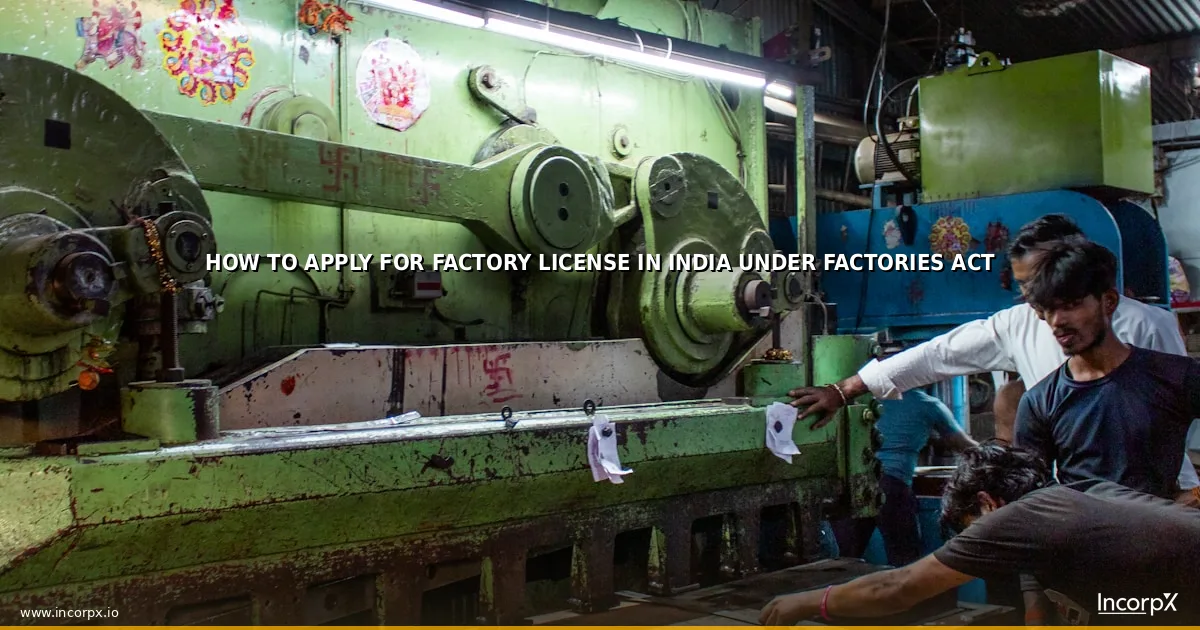
How to Apply for Factory License in India Under Factories Act
Apply for a factory license in India in 2026 under the Factories Act, 1948. Form 2 process, fees ₹500 to ₹10,000+, state portals, documents, and penalties.
Documents Required
- PAN Card of the occupier or company director
- Aadhaar Card or valid Passport of the occupier
- Factory building plan approved by a licensed architect or structural engineer
- Certificate of Stability (Form 25) signed by a qualified structural engineer
- Proof of land ownership or registered lease agreement for the factory premises
- Latest electricity bill or utility bill for the factory premises
- Certificate of Incorporation or business registration document for companies and LLPs
- NOC from the local municipal authority or town planning department
- Fire safety NOC from the State Fire Department
- List of manufacturing processes, machinery, and hazardous chemicals used on site
Tools & Prerequisites
- Registered account on the respective state labour department or DISH online portal
- Digital Signature Certificate (DSC) for online submission in states like Maharashtra and Tamil Nadu
- Internet banking or UPI access for payment of government fees on the portal
- Licensed structural engineer or competent person for signing Form 25 stability certificate
- Tax Professional or factory licence consultant for document verification and filing
A factory license in India is a mandatory statutory permit required under the Factories Act, 1948 before any manufacturing unit with 10 or more workers using power-driven machinery (or 20 or more workers without power) begins production. Obtaining this licence from the Chief Inspector of Factories involves building plan approval, a site inspection, payment of state-prescribed fees, and submission of the Certificate of Stability. This guide walks you through the entire process for 2026, including every form number, fee amount, state portal, and legal provision you need to know.
- A factory licence is mandatory under Section 6 of the Factories Act, 1948 for any premises employing 10 or more workers with power or 20 or more workers without power.
- The application is filed through Form 2 with the Chief Inspector of Factories in your state; on approval, the licence is issued in Form 3.
- Total cost to obtain a factory licence ranges from ₹15,000 to ₹50,000 including government fees, stability certificate, and professional charges.
- The licence must be renewed annually; operating with an expired licence attracts penalties of up to ₹1 lakh and 2 years' imprisonment under Section 92.
- Several states including Maharashtra and Tamil Nadu offer fully online applications through their dedicated portals.
What is a Factory Licence?
A factory licence is an official permit that authorises a premises to operate as a manufacturing factory under the provisions of the Factories Act, 1948.
Without this licence, no manufacturing activity may legally commence, regardless of the industry, product type, or scale of production. The licence specifies the name of the occupier, the factory premises address, the maximum number of workers permitted per shift, the nature of the manufacturing processes allowed, and the validity period (typically one calendar year). Displaying the original licence at the factory entrance is a statutory requirement under the Act.
The Factories Act, 1948 was enacted by the Parliament of India to regulate working conditions, ensure worker safety, and prevent exploitation in industrial establishments. The licensing requirement under the Act serves three purposes: it gives the state government a register of all industrial establishments within its jurisdiction, it enables regular inspections to ensure safety compliance, and it creates accountability by naming a specific occupier who bears legal responsibility for all violations.
Factory licences are issued by the state government through the Chief Inspector of Factories, a senior IAS or technical officer appointed under Section 8 of the Act. In practice, the District Inspector of Factories handles day-to-day processing of applications and refers complex cases to the Chief Inspector for final sign-off.
The Factories Act, 1948 (Central Act 63 of 1948) is the primary legislation governing factory licensing in India. While the Act is a central law, its administration is a State subject under Entry 22 of the Concurrent List of the Constitution. Each state frames its own Factory Rules (for example, the Maharashtra Factories Rules, 1963 or the Tamil Nadu Factories Rules, 1950) prescribing specific forms, fees, and procedures. The Act has been amended several times, most recently through the Occupational Safety, Health and Working Conditions Code, 2020, though the 1948 Act continues to govern licensing until the new Code is notified separately in each state.
Who Needs a Factory Licence in India?
Section 2(m) of the Factories Act, 1948 defines a "factory" as any premises including the precincts thereof where 10 or more workers are working or were working on any day of the preceding 12 months, and in any part of which a manufacturing process is being carried on with the aid of power; or where 20 or more workers are working or were working on any day of the preceding 12 months and in any part of which a manufacturing process is carried on without the aid of power. Both thresholds must be assessed annually, not just at the time of application.
The word "worker" under Section 2(l) includes every person employed directly or through a contractor, whether on piece-work or time-work, in any manufacturing process or in any other kind of work incidental to or connected with the manufacturing process. This means contract labourers, daily wage workers, and apprentices all count toward the threshold. If your unit crosses the threshold even once during the year, you need a licence for that year.
Manufacturing units that do not need a factory licence include units with fewer than the prescribed worker thresholds, mines (governed by the Mines Act, 1952), docks (governed by the Dock Workers Act), mobile units like construction sites (governed by the Building and Other Construction Workers Act, 1996), and government railways workshops (separately governed). However, such units still need other compliance documents like shop and establishment registration, MSME registration, and local body trade licences.
Based on our experience helping 10,000+ clients, many factory owners miss counting contract workers when assessing the 10-worker threshold under Section 2(m). If you engage contract labour through a contractor or labour supplier, those workers are counted in your factory's worker total for licensing purposes. A unit with 8 permanent workers and 5 contract workers crosses the 10-worker threshold and needs a factory licence immediately.
Types of Factory Licences
While the Factories Act, 1948 issues a single form of factory licence through Form 3, the practical requirements, inspection procedures, and compliance obligations differ significantly based on the category of factory. Understanding which category applies to your unit determines the depth of scrutiny during inspection and the additional approvals you need to obtain.
| Factory Type | Governing Provision | Additional Requirements | Inspection Frequency |
|---|---|---|---|
| General Manufacturing Factory | Section 6, Factories Act, 1948 | Form 2, Form 25 stability certificate, building plan approval | Once every 2 years (typical) |
| Hazardous Process Factory | Chapter IVA (Sections 41A to 41H) | Site Appraisal Committee clearance, Disaster Management Plan, Pollution Board consent | Annual, or more frequent |
| Seasonal Factory | Section 2(n), Section 85 | Separate notification of seasonal operation dates; shorter licence validity possible | At least once per season |
| New or Extended Factory | Section 6(1) proviso | Prior approval of building plans (Form 1) before construction starts | At plan approval stage and before operations |
| Electricity Generating Station | Section 85 (State notification) | CEA (Central Electricity Authority) clearances, boiler registration under Boilers Act, 1923 | Annual |
General Manufacturing Factory
This is the most common category and covers all manufacturing units producing goods using any process. General manufacturing factories producing textiles, plastics, metal parts, electronics, food products, chemicals, furniture, paper, or any other goods fall here. The licence is granted under Section 6 and renewed annually. Inspectors check worker welfare facilities, fire safety, machinery guarding, working hours, and overtime records during their visits.
Hazardous Process Factory
Factories that carry on any of the hazardous processes listed in Schedule 1 of the Factories Act, 1948 (which includes manufacture of explosives, processes using radioactive substances, manufacture or use of benzene, chlorinated organic solvents, heavy metals, and related chemical processes) need additional approvals under Chapter IVA. Before commencing operations, the occupier must submit a written report to the Chief Inspector under Section 41C containing detailed information on materials used, processes, emergency response plans, and worker health monitoring. A Site Appraisal Committee (SAC) reviews and approves such applications before the licence is granted.
Seasonal Factory
Factories that operate only during specific seasons (such as sugar mills, rice mills, fruit processing units, or salt works) are classified as seasonal factories under Section 2(n). The Chief Inspector issues licences for seasonal factories with validity limited to the declared season. The occupier must notify the Inspector 30 days before each season begins and 30 days before each season ends. Worker contract terms, overtime calculations, and welfare provisions apply differently for seasonal factories compared to general factories.
Documents Required for Factory Licence
Submitting an incomplete set of documents is the leading cause of factory licence application delays and rejections. Prepare and verify each document below before logging into the state portal or visiting the District Inspector's office.
- Form 2 Application (duly filled and signed): The formal application for registration and grant of factory licence prescribed under the state factory rules. Every section must be completed accurately. Incomplete Form 2 submissions are summarily returned without processing.
- Factory Building Plan (approved by Chief Inspector): A detailed architectural drawing showing the factory layout, machinery positions, emergency exit locations, firefighting equipment positions, sanitation facilities, and canteen area. Must be drawn to scale by a licensed architect and must carry the Chief Inspector's approval stamp under Form 1.
- Certificate of Stability (Form 25): A structural engineer's certificate confirming the factory building can safely bear the weight of the proposed machinery and the number of workers per floor. Must include the engineer's professional registration number and the maximum permissible floor load.
- PAN Card of the Occupier: Self-attested copy of the occupier's PAN card. For companies, submit the company PAN card and a board resolution naming the occupier as authorised signatory.
- Aadhaar Card or Passport of the Occupier: A government-issued photo identity document for KYC verification of the person named as occupier on the application.
- Proof of Land Ownership or Registered Lease Deed: Sale deed, property tax receipt, or a registered lease agreement of at least one year in the factory owner's name. Photocopies must be notarised or self-attested. If the premises are rented, the rent agreement must be registered with the Sub-Registrar's office.
- Latest Electricity Bill for the Factory Premises: A recent electricity bill (not older than 3 months) as address proof for the factory premises and evidence of power connection, which is relevant to determining whether the factory uses power-driven processes.
- Certificate of Incorporation (for Companies and LLPs): A copy of the Certificate of Incorporation issued by the Ministry of Corporate Affairs confirming the legal existence of the company or LLP that owns the factory.
- NOC from the Local Municipal Authority: A No Objection Certificate from the municipal corporation or gram panchayat confirming the factory premises is located in an area zoned for industrial use and confirming no violation of local town planning laws.
- Fire Safety NOC from the State Fire Department: A No Objection Certificate from the State Fire Department confirming the factory has adequate fire extinguishers, water hydrants, fire exits, and an approved fire safety plan. Required before the Inspector conducts the site inspection.
- List of Manufacturing Processes and Machinery: A typed list describing each manufacturing process undertaken in the factory, each machine installed (name, model, and horsepower), and any hazardous chemicals or materials used.
- Worker List with Shift Details: A statement showing the maximum number of workers proposed per shift and the number of shifts proposed per day. This determines the licence fee category and the worker amenities required.
Many applicants submit an unapproved building plan or a self-prepared plan instead of a plan approved by the Chief Inspector under Form 1. The Chief Inspector will reject Form 2 if the building plan does not carry the official Form 1 approval stamp. Get plan approval first, wait for the approved plan to be returned, and then attach it to your Form 2 submission. Skipping plan approval adds 2 to 4 weeks to your overall timeline.
Step-by-Step Factory Licence Application Process
The process to obtain a factory licence under the Factories Act, 1948 has 9 sequential stages. Each stage must be completed before the next can begin. Attempting to file Form 2 before obtaining plan approval under Form 1, for example, will result in outright rejection. Follow the sequence carefully.
Step 1: Confirm Your Unit Qualifies as a Factory
Count all workers engaged in or in connection with any manufacturing process on your premises, including contract workers, temporary workers, and piece-rate workers. If the total is 10 or more and your unit uses power-driven machinery, you need a factory licence. If the total is 20 or more even without power, the licence is required. Also confirm that a "manufacturing process" as defined under Section 2(k) of the Act is carried out on the premises. The Factories Act's definition of manufacturing process is broad and includes making, altering, ornamenting, finishing, packing, oiling, washing, cleaning, breaking up, or otherwise treating or adapting any article with a view to its use, sale, transport, delivery, or disposal.
If your unit is at or near the threshold, take a conservative position and apply for the licence. Operating just above the threshold without a licence is still a criminal offence, and courts look at the maximum number of workers employed on any single day during the year to determine liability.
Based on our experience helping 10,000+ clients, units that cross the threshold mid-year often discover this only during a surprise inspection. We recommend applying for the factory licence as a precaution whenever your worker count is between 8 and 12, as fluctuations can push you over the statutory threshold without warning.
Step 2: Send the Section 7 Notice to the Chief Inspector
Under Section 7 of the Factories Act, 1948, the occupier must send a written notice to the Chief Inspector of Factories at least 15 days before the factory is occupied or before operations begin. The notice is a statutory requirement, not a form available on all online portals. Draft the notice on company letterhead and address it to the Chief Inspector of Factories of your state. Include: the name and postal address of the occupier, the name and address of the factory, the address to which official communications must be sent, the nature of the manufacturing process to be carried on, the total horsepower installed or to be installed, and the number of workers proposed to be employed.
Send this notice by registered post or courier with acknowledgement and retain the delivery confirmation. Many state portals now integrate this notice submission into the Form 2 application process, so check your state's portal first before sending a separate physical notice.
Step 3: Obtain Factory Building Plan Approval (Form 1)
Before constructing a new factory, extending an existing one, or occupying any premises as a factory for the first time, the occupier must apply for building plan approval using Form 1 (application for permission to construct, extend, or use a building as a factory) as prescribed under the state factory rules. Prepare the factory building plan with the help of a licensed architect. The plan must show: the factory layout with dimensions, the positions and types of all machinery, the location of fire extinguishers and hydrants, all entry and exit points including emergency exits, the positions of workers' welfare facilities (restrooms, locker rooms, first aid rooms), and the canteen if worker count exceeds 250. Submit Form 1 along with the building plan to the Chief Inspector's office or upload through the state portal. The Chief Inspector schedules a site inspection before approving the plan. Plan approval fees range from ₹2,000 to ₹5,000 depending on the state and factory area. Allow 7 to 15 working days for plan approval.
Applicants often begin factory construction before receiving Form 1 plan approval, assuming they can apply for the licence afterwards. This is a violation of Section 6(1) of the Factories Act and the Chief Inspector has powers to order demolition of non-approved structures. Always wait for written plan approval before commencing construction or modification of the factory building.
Step 4: Get the Certificate of Stability (Form 25)
Engage a qualified structural engineer licensed in your state to inspect the factory building and issue a Certificate of Stability in Form 25 as prescribed under the state rules. The engineer must certify: the type and condition of the building structure, the maximum permissible load per floor in kilograms per square metre, that the building is safe for the proposed number of workers and machinery loads, and that the building complies with applicable construction standards. The engineer must include their professional registration number, qualification, and contact information on the certificate. Form 25 must be renewed periodically (usually every 5 years for permanent structures, or annually for pre-fabricated or older structures). Structural engineer fees for Form 25 range from ₹2,000 to ₹10,000 depending on factory size and structural complexity. Attach the original signed Form 25 to your Form 2 application. Photocopies are not accepted by most state Inspectorates.
Step 5: Collect Fire Safety NOC and Municipal NOC
Visit the nearest State Fire Station to obtain a Fire Safety NOC confirming that the factory premises has adequate firefighting infrastructure. The fire officer will inspect the premises and verify: number and type of fire extinguishers relative to floor area, position and accessibility of hydrants, presence of a sprinkler system if required, width and clearance of all emergency exits, and the existence of a posted fire evacuation plan. Fire Safety NOC fees range from ₹1,000 to ₹5,000 depending on factory size and state. Separately, obtain a NOC from the local municipal authority (municipal corporation or gram panchayat) confirming the premises is in an industrially zoned area. Both NOCs must be recent (not older than 6 months at the time of Form 2 submission).
Step 6: File Form 2 Online or Offline
With all documents ready, proceed to file Form 2 (Application for Registration and Grant of Licence) as prescribed under your state's factory rules. In states with online portals, log in to the portal, select the "New Factory Licence" application type, fill all fields carefully including worker count per shift, total installed horsepower, nature of manufacturing process, and names of all proposed supervisors, and upload scanned copies of all required documents. In states without online portals, submit Form 2 in triplicate along with all supporting documents at the office of the District Inspector of Factories. The Inspector provides an acknowledgement receipt that you can use to track application status.
Pay the prescribed government fees at the time of submission. Online portals accept net banking, debit/credit cards, and UPI. Offline submissions require a bank demand draft or treasury challan in favour of the Chief Inspector of Factories of your state. Government fees range from ₹500 to ₹10,000+ depending on worker count and horsepower. Retain the fee payment receipt.
Step 7: Site Inspection by the Factory Inspector
After reviewing the Form 2 application and uploaded documents, the Chief Inspector assigns a Factory Inspector for a site inspection of the factory premises. The inspection is scheduled within 7 to 21 working days of the application date. The Inspector verifies: that the factory building matches the approved Form 1 plan, that all machinery is properly guarded and positioned, that fire safety equipment is in place and functional, that workers' welfare facilities including rest rooms, first aid box, drinking water points, canteen (if applicable), and locker rooms are provided, that lighting and ventilation meet the prescribed standards, and that hazardous materials are properly stored and labelled. Be present at the factory during the inspection and have all original documents available for the Inspector's review. If deficiencies are found, the Inspector issues a deficiency notice listing the corrective actions required.
Based on our experience helping 10,000+ clients, factories that prepare a pre-inspection checklist covering all provisions in Chapters III, IV, and V of the Factories Act, 1948 (dealing with health, safety, and welfare respectively) consistently clear inspections in one visit. Arrange a dry run internal inspection before the official visit to spot and fix issues proactively.
Step 8: Address Deficiencies and Get Re-Inspected
If the Inspector identifies non-compliances during the site inspection, a written deficiency notice is issued specifying each deficiency and the deadline for rectification (typically 15 to 30 calendar days). Rectify all deficiencies within the specified period and submit a compliance report to the Inspector with supporting evidence (photographs, purchase invoices for equipment, certificates from contractors). The Inspector then schedules a re-inspection. A fresh re-inspection fee of ₹500 to ₹2,000 may be charged in some states. If all deficiencies are resolved to the Inspector's satisfaction, the file is referred to the Chief Inspector for licence issuance.
Step 9: Receive Factory Licence in Form 3
Upon the Inspector's satisfactory report, the Chief Inspector of Factories issues the factory licence as Form 3 (Certificate of Registration). In online states, the signed Form 3 is made available for download from the portal. In other states, the original Form 3 is sent by registered post or collected from the Inspectorate office. The Form 3 certificate specifies: the occupier's name and address, the factory name and location, the permitted maximum number of workers per shift (day, second, night), the nature of manufacturing processes permitted, the total installed horsepower, and the validity date (usually December 31 of the current year). Frame and display the original Form 3 certificate at the factory entrance, the main gate, and the factory manager's office as required by the Act.
Many factory owners keep the Form 3 licence locked in a file. The Factories Act, 1948 specifically requires the licence to be displayed prominently at the factory. During inspections, failure to display the licence is itself treated as a violation and attracts separate fines. Make three certified copies, laminate one for display, and store the original in a fireproof document cabinet.
Factory Licence Fees in 2026
Factory licence fees are prescribed by each state government under the factory rules and are revised periodically. Fees are calculated on a combination of worker count and total installed horsepower. The table below shows general fee ranges based on Maharashtra's fee schedule as an illustrative example (other states follow broadly similar structures with variations).
| Fee Component | Amount (General Range) | Notes |
|---|---|---|
| Plan Approval Fee (Form 1) | ₹2,000 to ₹5,000 | One-time; varies by factory area and state |
| Factory Registration Fee (one-time) | ₹50 to ₹500 | Paid once; separate from annual licence fee |
| Annual Licence Fee (up to 50 workers) | ₹500 to ₹1,500 | Maharashtra: ₹750 for up to 50 workers |
| Annual Licence Fee (51 to 100 workers) | ₹1,500 to ₹3,000 | Maharashtra: ₹1,500 for 51 to 100 workers |
| Annual Licence Fee (101 to 500 workers) | ₹3,000 to ₹7,500 | Increases in bands; also factored with HP |
| Annual Licence Fee (500+ workers) | ₹7,500 to ₹15,000+ | Hazardous process factories pay more |
| Certificate of Stability (Form 25) | ₹2,000 to ₹10,000 | Professional fee paid to structural engineer |
| Fire Safety NOC | ₹1,000 to ₹5,000 | Paid to State Fire Department |
| Professional/Consultant Charges | ₹5,000 to ₹25,000 | Optional; varies by complexity |
| Late Renewal Penalty (if applicable) | 25 to 50% of annual fee | Charged if renewal is filed after January 31 |
State-specific notes: Tamil Nadu uses a slab structure based on workers and HP separately, resulting in fees of ₹1,000 to ₹20,000 for larger factories. Karnataka recently revised its fee schedule upward in 2024 for factories with more than 200 workers. Gujarat offers a concessional fee structure for factories registered under the state's industrial park policy. Always verify the exact fee schedule on your state's portal before making payment, as state governments revise fees through government gazettes periodically.
Factory Licence Validity and Renewal
A factory licence issued under the Factories Act, 1948 is valid for one calendar year from January 1 to December 31. The licence must be renewed before December 31 each year to ensure uninterrupted production. Most state rules require renewal applications to be filed by November 30 of the current year so that the renewed licence is received before the new year begins.
Renewal Process
The factory licence renewal process is simpler than the initial application. File the renewal through the same state portal used for the original application. Log in, navigate to "Renewal of Existing Factory Licence," verify and update the worker count, horsepower, and any changes in manufacturing processes or occupier details, upload the renewed Certificate of Stability (Form 25) if due for renewal, and pay the applicable annual licence fee. No site inspection is scheduled for routine renewals unless: (a) the Inspector's database flags pending compliance issues, (b) there has been a reportable accident since the last renewal, or (c) the occupier has changed significant manufacturing processes or added new machinery beyond the capacity specified in the current licence.
Changes Requiring Licence Amendment
Between renewal cycles, certain changes require the occupier to apply for a licence amendment rather than waiting for the annual renewal. These include: increasing the permitted worker count per shift by more than 10 percent, adding a new manufacturing process not covered in the current licence, installing additional machinery that materially increases the installed horsepower, changing the occupier's name (due to ownership transfer or company merger), or shifting to a new premises. File the amendment application within 30 days of the change. Late amendment filings attract the same penalties as licence violations.
Multi-Year Licences
Some states (including Tamil Nadu and Karnataka) allow factories to apply for a multi-year licence covering 3 to 5 years by paying the aggregate annual fees upfront at a small discount. Multi-year licences reduce the administrative burden on occupiers and are recommended for factories with stable worker counts and processes. Check your state's current rules on multi-year licences before applying, as not all states offer this option.
After Getting Your Factory Licence
Obtaining the factory licence is the beginning, not the end, of your compliance obligations under the Factories Act, 1948. The Act imposes a wide range of ongoing obligations on the occupier relating to worker safety, health, welfare, working hours, and record-keeping. Non-compliance with any of these provisions is an offence even if the licence is current.
| Post-Licence Obligation | Statutory Deadline | Penalty for Non-Compliance |
|---|---|---|
| Display Factory Licence (Form 3) at entrance | From date of issue, continuously | Fine under Section 92 of the Act |
| Maintain accident register and report serious accidents to Inspector within 12 hours | Within 12 hours of any reportable accident | Imprisonment up to 3 months or fine up to ₹25,000 |
| Maintain register of workers (adult workers register) | Continuously; available for inspection at all times | Fine up to ₹1 lakh under Section 92 |
| Provide first aid boxes (1 per 150 workers) | At all times during working hours | Fine under Section 92 |
| Provide canteen if 250 or more workers are employed | From date of crossing 250-worker threshold | Fine under Section 92 |
| File annual return with Chief Inspector | By January 31 for the preceding calendar year | Fine up to ₹1 lakh under Section 92 |
| File half-yearly return (in applicable states) | By July 31 and January 31 | Fine under state factory rules |
| Renew factory licence | By November 30 for the following year | Late penalty 25 to 50% of fee; prosecution under Section 92 |
| Conduct medical examination of workers in hazardous factories | Pre-employment and annual | Fine under Section 92; OHSAS liability |
| Notify Chief Inspector of any change in occupier | Within 30 days of change | Both old and new occupier liable under Section 92 |
Factory owners must also register separately for Provident Fund (PF) under the Employees' Provident Funds and Miscellaneous Provisions Act, 1952 if they employ 20 or more workers, and for ESI under the Employees' State Insurance Act, 1948 if they employ 10 or more workers (in factory premises covered by the ESI Act). Professional Tax registration and GST registration are also typically needed by manufacturing factories.
State-Wise Factory Licence Portals
Factory licences are administered by state governments, and each state has its own online portal or offline process. The table below lists the key portals and authorities for major industrial states. Always check the current URL directly through a browser search as portal addresses change after government IT upgrades.
| State | Issuing Authority | Online Portal | Offline Office |
|---|---|---|---|
| Maharashtra | Directorate of Industrial Safety & Health (DISH) | dish.maharashtra.gov.in | DISH Regional Office (Mumbai, Pune, Nagpur, etc.) |
| Tamil Nadu | Directorate of Industrial Safety and Health | tnlabour.in | District Inspector of Factories, Chennai/Districts |
| Karnataka | Department of Factories, Boilers, Industrial Safety and Health | labour.karnataka.gov.in | District Factories Inspector, Bengaluru/Districts |
| Gujarat | Directorate of Industrial Safety & Health | dish.gujarat.gov.in | District Inspector of Factories, Gandhinagar/Districts |
| Uttar Pradesh | Labour Department, UP | uplabour.gov.in | Deputy Chief Inspector of Factories, Lucknow/Districts |
| Delhi | Delhi Factory Inspectorate | labour.delhi.gov.in | Chief Inspector of Factories, Delhi Secretariat |
| Rajasthan | Department of Factories and Boilers | labour.rajasthan.gov.in | Chief Inspector of Factories, Jaipur |
| West Bengal | Directorate of Factories | wblabour.gov.in | Chief Inspector of Factories, Kolkata |
| Telangana | Department of Factories | labour.telangana.gov.in | Chief Inspector of Factories, Hyderabad |
| Andhra Pradesh | Department of Factories | labour.ap.gov.in | Chief Inspector of Factories, Amaravati |
For states not listed above, search for "[State name] Chief Inspector of Factories" on the National Government Services Portal at services.india.gov.in to locate the current application portal. The DGFASLI website at dgfasli.gov.in also maintains links to state factory inspectorates and the latest central advisory notifications.
Common Mistakes and How to Avoid Them
Factory licence applications fail or get delayed most often because of avoidable errors. The mistakes below are based on patterns observed across hundreds of factory licence applications in India. Addressing each one before filing saves weeks of back-and-forth with the Inspectorate.
Mistake 1: Skipping Plan Approval Before Applying for the Licence
Form 1 building plan approval must be obtained before Form 2 for the factory licence. Applicants who submit Form 2 without an approved plan receive a rejection notice within days. The fix is simple: complete the Form 1 process first, obtain the stamped and signed approval, and then attach it as a mandatory document with Form 2. Do not assume that attaching an architect's plan without the Chief Inspector's approval will suffice.
Mistake 2: Using an Outdated Certificate of Stability
Some applicants reuse the Certificate of Stability (Form 25) from a previous application or from an earlier year. Inspectorates require Form 25 to be dated within 6 months of the licence application date. An outdated stability certificate is a common rejection ground. Schedule the structural engineer's assessment and get Form 25 signed close to the date you plan to file Form 2.
Mistake 3: Incorrect Worker Count Leading to Wrong Fee Calculation
Underreporting the worker count to pay a lower licence fee is both a compliance violation and a practical problem. If the Inspector finds more workers on site than the licence permits, the excess workers are treated as unlicensed, and the occupier faces prosecution. Always declare the maximum number of workers expected per shift across the entire year, not just the number currently employed. Overestimating the worker count slightly is far better than underestimating it.
Mistake 4: Submitting Photocopies of Documents That Require Originals
Most Inspectorates require original signed copies of Form 25 (Certificate of Stability), the NOC from the municipal authority, and the fire safety NOC. Submitting photocopies of these documents causes rejection. Verify the originals-versus-copies requirement with the specific state Inspectorate or portal FAQ before submitting. For online submissions, high-resolution scans (minimum 300 DPI) of original documents are generally accepted in place of physical originals.
Mistake 5: Failing to Notify the Chief Inspector Before Starting Production
The Section 7 notice must be sent at least 15 days before occupying the premises as a factory. Many first-time factory owners complete their building construction, install machinery, and then discover they needed to send the notice before any of this. While the notice is sent before production and the licence application can happen in parallel, failing to send the 15-day advance notice is a separate offence under the Act, independent of whether the licence is eventually obtained.
Mistake 6: Not Accounting for All Compliance Costs in the Budget
The government licence fee is often the smallest component of the total cost. Stability certificate charges, fire safety NOC fees, architectural plan fees, municipal NOC charges, and professional consultant fees together can add ₹10,000 to ₹30,000 on top of the government fee. Budgeting only the government fee and then being surprised by these additional costs causes delays when factory owners try to arrange additional funds mid-process. Prepare a comprehensive cost estimate covering all components before starting.
Never begin production while the factory licence application is "pending inspection." Operating during the pendency of a new application, after the licence has expired, or after a licence has been suspended is treated as operating without a licence under the Factories Act, 1948 and attracts the full penalties under Section 92. Wait for the written Form 3 certificate before starting any manufacturing activity.
Penalties for Operating Without a Factory Licence
The Factories Act, 1948 prescribes serious criminal penalties for non-compliance with licensing requirements. These penalties apply to the occupier personally, not just to the company, which means the individual managing director, partner, or owner faces criminal prosecution. Courts treat factory licensing violations seriously because they directly affect worker safety.
Section 92: General Penalty for Offences
Section 92 of the Factories Act, 1948 is the primary penalty provision. Any person who contravenes any provision of the Act or any rule made thereunder or any order made under this Act is punishable with imprisonment for a term extending up to 2 years, or with a fine that may extend to ₹1,00,000, or with both. Operating without a factory licence, failing to obtain plan approval, working beyond the permitted worker count, or failing to file annual returns are all offences attracting Section 92 penalties. Courts can sentence the occupier and, in certain cases, the factory manager to prison even for first offences if the violation is serious.
Section 93: Enhanced Penalty After Previous Conviction
Section 93 provides for enhanced penalties when the accused has been convicted of any offence under the Act previously. On a second or subsequent conviction for the same offence, the minimum fine increases to ₹10,000 per day for each day the offence continues after the first conviction, with the total fine that may extend up to ₹2,00,000. Repeated non-compliance with factory licensing requirements is treated as a continuing offence, meaning a new offence is committed on each day the violation continues.
Section 94: Penalty for Obstructing Inspector
Section 94 makes it a criminal offence to obstruct, prevent, hinder, or otherwise interfere with a Factory Inspector exercising any power under the Act. Factory owners who refuse entry to an Inspector, conceal documents during an inspection, provide false information, or use intimidation to obstruct inspection face imprisonment up to 6 months or a fine up to ₹10,000 or both. Cooperation with inspections is not optional; it is legally mandated.
Section 95: Penalty for Wrongful Disclosure of Results of Analysis
Section 95 penalises persons who disclose the results of any analysis of substances taken from a factory in a manner that is not authorised. This provision applies mainly to situations where workplace hazardous substance test results are published or shared in ways that prejudice the factory owner's trade secrets or reputation without authorisation. It is less commonly invoked than Sections 92 to 94 but is relevant for chemical and pharmaceutical factories where substance analysis is routine.
Based on our experience helping 10,000+ clients, factories that engage a qualified factory compliance consultant for annual audits before the Inspector's visit rarely face penalty notices. A pre-inspection audit covering Chapters III (health), IV (safety), V (welfare), VI (working hours), and VII (employment of young persons) systematically identifies gaps and allows time for correction before the official visit.
Factory Licence vs. Other Business Licences: A Quick Comparison
Manufacturing businesses often need multiple licences operating simultaneously. Understanding which licence serves which purpose prevents confusion when regulatory officers from different departments conduct inspections.
The factory licence under the Factories Act, 1948 is specific to the physical manufacturing premises and focuses on worker safety, health, and welfare during the production process. It is issued by the state labour department's Chief Inspector of Factories and must be renewed every year. Every change in worker count, horsepower, or manufacturing process requires an amendment to this licence.
The shop and establishment registration covers commercial activity on the premises (such as a front office, sales counter, or administrative block attached to the factory). Even factories need shop and establishment registration for their office staff. Municipal authorities and state labour departments issue this registration, and it is typically permanent with periodic renewal requirements varying by state.
The trade licence from the local municipal corporation certifies that the business activity being conducted at a particular premises complies with zoning and municipal regulations. Many municipal corporations require factories to hold both a shop and establishment certificate and a trade licence. The trade licence must be renewed annually and is tied to the address, not the business entity.
The CLRA labour licence under the Contract Labour (Regulation and Abolition) Act, 1970 is required when the factory engages 20 or more contract workers through a contractor. This licence is obtained by both the principal employer (factory owner) and the contractor. The principal employer must register under CLRA first, following which each contractor engaged by the factory must separately obtain a CLRA contractor licence.
The contractor licence is required by entities that supply contract labour to factories and other establishments employing contract workers above the threshold. If your factory uses its own construction or maintenance contractors who supply workers, those contractors need contractor licences under CLRA.
| Licence | Issuing Authority | Who Needs It | Validity |
|---|---|---|---|
| Factory Licence (Form 3) | Chief Inspector of Factories, State Government | Any factory with 10+ workers (power) or 20+ workers (no power) | Annual (January to December) |
| Shop & Establishment Registration | Municipal Corporation / Labour Department | All commercial establishments including factory offices | Permanent or annual (state-specific) |
| Trade Licence | Local Municipal Corporation / Panchayat | All businesses operating from a fixed premises | Annual |
| CLRA Registration (Principal Employer) | Registering Officer, State Labour Department | Factories engaging 20+ contract workers | Annual |
| MSME Registration (Udyam) | MSME Ministry (self-certification, online) | Manufacturing and service units below MSME thresholds | Permanent (no renewal) |
| GST Registration | GST Council / GSTN portal | Factories with turnover above ₹40 lakh | Permanent (cancellation on request) |
Factory Licence for Specific Industries
While the Factories Act, 1948 applies to all manufacturing units above the worker threshold, specific industries face additional regulatory layers on top of the standard factory licence. Understanding these industry-specific requirements before applying saves time and avoids surprises during the Inspector's visit.
Food Processing Factories
Food manufacturing units need a factory licence under the Factories Act, 1948 and an FSSAI (Food Safety and Standards Authority of India) licence or registration under the Food Safety and Standards Act, 2006. The FSSAI licence category (basic registration, state licence, or central licence) depends on the annual turnover and geographic reach of the food business. Additionally, food factories with canteens for workers above 250 must comply with food safety standards even for the in-house canteen, adding a second FSSAI compliance dimension.
Chemical and Pharmaceutical Factories
Chemical factories and pharmaceutical manufacturers face the most comprehensive compliance requirements. Beyond the factory licence, they need Pollution Control Board (PCB) consent to establish and consent to operate under the Environment Protection Act, 1986 and Air and Water Acts. Pharmaceutical factories need a Drug Manufacturing Licence under the Drugs and Cosmetics Act, 1940. Factories handling hazardous chemicals as defined under the Manufacture, Storage and Import of Hazardous Chemicals (MSIHC) Rules, 1989 must also maintain safety data sheets and conduct periodic on-site emergency planning exercises.
Textile and Garment Factories
Textile and garment factories face the standard factory licence requirements plus state-specific rules on loom hours, night shift restrictions for women workers, and mandatory welfare officer appointment (for factories with 500 or more workers). Some states also regulate the use of specific dyes and chemicals in textile processing under state PCB rules. Factories in textile hubs like Tirupur, Surat, and Bhiwandi often face simultaneous inspection from both factory and pollution control authorities.
Boiler-Operated Factories
Factories that use steam boilers, common in paper mills, textile factories, and food processing plants, need separate boiler registration under the Boilers Act, 1923 in addition to the factory licence. Boiler registration is obtained from the Boiler Inspectorate of the state and requires annual inspection by a competent boiler inspector. The factory licence and boiler registration are maintained separately, and an expired boiler registration is an independent ground for prosecution regardless of the factory licence status.
Factories in Special Economic Zones (SEZ)
Factories located within Special Economic Zones (SEZs) must comply with both the Factories Act, 1948 and the Special Economic Zones Act, 2005 along with the SEZ Rules, 2006. The Development Commissioner of the SEZ coordinates with the Chief Inspector of Factories for issuing factory licences within the zone. SEZ factories benefit from simplified inspection procedures in some zones but are subject to stricter export documentation and customs compliance. Factories within Export Processing Zones (EPZs) follow similar dual regulatory requirements.
Related Resources
A factory licence is one component of a broader compliance framework for manufacturing businesses in India. The resources below cover the other registrations and licences that most factories need alongside their factory licence.
- Factory License Registration Service - Let our experts handle your complete factory licence application from Form 1 to Form 3, including document preparation, portal filing, and Inspector coordination.
- Factory Plan Approval - Get your factory building plan prepared, reviewed, and approved by the Chief Inspector through our architect and compliance network.
- Fire Safety License - Obtain your fire safety NOC from the State Fire Department as a pre-condition for factory licence application.
- MSME Registration (Udyam) - Every manufacturing factory should register as an MSME to access priority sector credit, government tenders, and technology subsidies.
- PF Registration - Factories employing 20 or more workers must register under the Employees' Provident Funds and Miscellaneous Provisions Act, 1952.
- ESI Registration - Factories employing 10 or more workers covered under the ESI Act must register under the Employees' State Insurance Act, 1948.
- CLRA Labour License - Factories that engage contract workers through a contractor need to register under the Contract Labour (Regulation and Abolition) Act, 1970.
- Professional Tax Registration - Factories in Maharashtra, Karnataka, Tamil Nadu, and other PT-applicable states must deduct and remit professional tax on employee salaries.
- GST Registration - Manufacturing factories with turnover above ₹40 lakh for goods (₹20 lakh for services) must register under GST and file monthly returns.
- Compliance Services - Ongoing factory compliance management including annual return filings, licence renewals, Inspector visit support, and worker register maintenance.
- Guide: How to Register MSME/Udyam for an Existing Business - Step-by-step walkthrough of the Udyam registration process for manufacturing factories already in operation.
- Blog: Gumasta License Registration Process and Fees - Detailed overview of the Gumasta (Shop Act) licence, which is required for the commercial aspects of factory operations in Maharashtra.
Summary
A factory licence is a non-negotiable legal requirement for any manufacturing unit crossing the 10-worker-with-power or 20-worker-without-power threshold under Section 2(m) of the Factories Act, 1948. The process involves obtaining building plan approval through Form 1, securing a Certificate of Stability in Form 25, filing Form 2 with the Chief Inspector of Factories, completing a site inspection, paying government fees of ₹500 to ₹10,000 or more, and receiving the Form 3 licence certificate. Operating without a valid licence exposes the occupier to criminal prosecution under Section 92 with penalties up to ₹1 lakh and 2 years' imprisonment. Visit our factory license registration service page to start your application with expert support today.
Frequently Asked Questions
What is a factory licence under the Factories Act, 1948?
Which factories must obtain a licence in India?
Who issues a factory licence in India?
What is Section 6 of the Factories Act, 1948?
What is Form 2 under the Factories Act?
What is Form 3 in factory licensing?
What is the notice required under Section 7 of the Factories Act?
Is a factory licence different from a trade licence?
What documents are needed for a factory licence application?
How long does it take to get a factory licence in India?
What is Form 25 or the Certificate of Stability?
What is Form 1 used for in factory registration?
Can I apply for a factory licence online?
What happens if a deficiency is found during site inspection?
Who is an occupier under the Factories Act, 1948?
What are the government fees for a factory licence in India?
What is the total cost to get a factory licence in India?
Are factory licence fees paid every year?
Is there a fee for the stability certificate from a structural engineer?
What is the plan approval fee for a factory building?
What is the difference between a factory licence and a factory registration?
Is a factory licence required for a home-based manufacturing unit?
How is a factory licence different from an MSME registration?
What is the difference between a factory licence and a shop and establishment licence?
Do hazardous process factories need additional approvals beyond the factory licence?
What are common reasons for factory licence application rejection?
Can I start production before getting a factory licence?
What happens if a factory licence expires and is not renewed?
Can a factory licence be transferred to a new owner?
What is the role of DGFASLI in factory licensing?
Need Help With This Process?
Our experts are ready to assist you every step of the way. Get started with a free consultation today!





 Nebin Binoy