Semiconductor Company Setup in India: PLI Scheme, DLI, and Registration
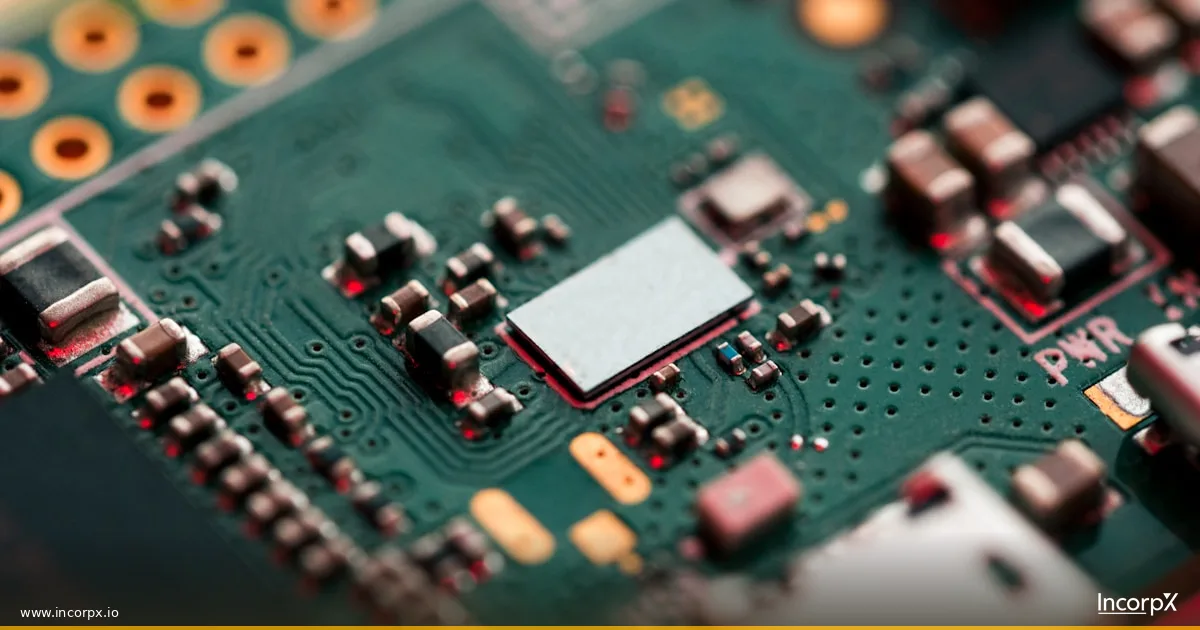
India imported semiconductors worth over USD 42 billion in FY2024-25, making chips the country's second-largest import category after crude oil. To reverse this dependency, the Indian government committed ₹76,000 crore under the India Semiconductor Mission and approved projects worth ₹1.52 lakh crore by early 2025. Tata Electronics is building India's first commercial silicon fab in Dholera, Gujarat. Micron Technology is constructing a USD 2.75 billion ATMP facility in Sanand. CG Power, Kaynes Technology, and multiple chip design startups have received government backing. The semiconductor PLI scheme now covers 50% of project cost across all technology nodes. For chip design startups, the Design Linked Incentive scheme offers up to ₹15 crore in product development support and 6-8% of net sales for 5 years. If you are planning to set up a semiconductor company in India, this guide covers every scheme, registration step, license, and compliance requirement you need to know in 2026.
- The India Semiconductor Mission (ISM) has a total outlay of ₹76,000 crore to build a domestic chip ecosystem
- Modified PLI Scheme covers 50% of project cost for semiconductor fabs, compound semiconductor fabs, and ATMP/OSAT units
- Design Linked Incentive (DLI) scheme offers up to ₹15 crore per company for chip design plus 6-8% of net sales for 5 years
- Approved projects by Tata, Micron, CG Power, and Kaynes total over ₹1.52 lakh crore in investment
- 100% FDI is allowed in semiconductor manufacturing under the automatic route
- Private Limited Company is the required structure for PLI scheme eligibility and foreign investment
- India's first commercial fab (Tata-PSMC in Dholera) is expected to begin production by late 2026 or early 2027
India's Semiconductor Opportunity: Why Now?
India's electronics production crossed ₹10.2 lakh crore in FY2024-25, growing at over 17% annually. Yet nearly every electronic device manufactured in India relies on imported chips. This structural gap is what the government's semiconductor push aims to fix.
Three forces are converging to make 2025-2026 the inflection point. First, global supply chain diversification after the COVID-era chip shortage forced companies to look beyond Taiwan and South Korea. Second, India's domestic demand for semiconductors is projected to reach USD 55 billion by 2026, driven by 5G rollout, EV adoption, and data centre expansion. Third, the government incentive structure is now the most aggressive among emerging semiconductor nations, with 50% fiscal support matching or exceeding the US CHIPS Act and the EU Chips Act.
For entrepreneurs and companies entering this space, the window of opportunity is defined by scheme timelines. The Modified PLI Scheme applications are processed through ISM. DLI scheme cohorts are accepting applications for chip design startups. Companies that register and apply early gain priority access to incentive disbursements, industrial land allotment, and government co-investment. The supporting ecosystem of EDA tools, foundry access, and trained engineers (over 125,000 design engineers in India) is more mature than at any point in the past.
India Semiconductor Mission: Structure, Budget, and Scope
The India Semiconductor Mission (ISM) was established in December 2021 within MeitY as the nodal agency for all semiconductor-related policy, incentives, and project approvals. ISM administers four core schemes covering the entire semiconductor value chain:
| Scheme | Coverage | Incentive | Target |
|---|---|---|---|
| Modified PLI for Semiconductor Fabs | Silicon and compound semiconductor fabrication | 50% of project cost | 2-3 commercial fabs by 2030 |
| Modified PLI for ATMP/OSAT | Assembly, testing, marking, packaging, outsourced semiconductor assembly and test | 50% of project cost | 3-5 OSAT/ATMP units |
| Design Linked Incentive (DLI) | Semiconductor chip design companies and startups | Up to 50% of design cost (max ₹15 crore) + 6-8% of net sales for 5 years | 100 design companies over 5 years |
| Chips-to-Startup (C2S) | Academic training, EDA tool access, foundry credits | Free EDA tools + fabrication credits + mentorship | 85,000 trained engineers by 2027 |
The total outlay stands at ₹76,000 crore, making it one of the largest sector-specific industrial incentive programmes in Indian history. ISM also coordinates with state governments on land allotment, power supply guarantees, water infrastructure, and environmental clearances for approved projects.
PLI Scheme for Semiconductor Fabs: How It Works
The Modified Programme for Development of Semiconductors and Display Manufacturing Ecosystem offers a uniform 50% fiscal support of project cost for all technology nodes. The modified scheme, approved by the Union Cabinet in September 2023, replaced the original 2021 version that offered tiered incentives based on technology node.
What Qualifies as a Semiconductor Fab
The scheme covers three categories of fabrication facilities:
- Silicon semiconductor fabs: Facilities manufacturing integrated circuits on silicon wafers at any technology node (28nm, 45nm, 65nm, 90nm, 130nm, 180nm, and above)
- Compound semiconductor fabs: Facilities using materials like gallium arsenide (GaAs), gallium nitride (GaN), silicon carbide (SiC), and indium phosphide (InP) for RF, power, and optoelectronic devices
- Silicon photonics fabs: Facilities manufacturing photonic integrated circuits combining optical and electronic components on silicon substrates
Fiscal Support Structure
The 50% fiscal support is disbursed in phases linked to project milestones, released as capital expenditure reimbursement upon verification of actual investment. State governments contribute additional incentives. Gujarat offers subsidized land, power tariff concessions, stamp duty exemptions, and capital subsidy top-ups. Karnataka, Tamil Nadu, Odisha, and Telangana have also announced state-level semiconductor policies.
Approved Fab Projects as of 2025
| Company | Project Type | Location | Investment | Status |
|---|---|---|---|---|
| Tata Electronics (with PSMC) | Silicon fab (28nm, 40nm) | Dholera SIR, Gujarat | ₹91,000 crore | Under construction; production expected late 2026 or early 2027 |
| Tata Semiconductor (TSAT) | ATMP unit | Morigaon, Assam | ₹27,000 crore | Under construction |
| Micron Technology | ATMP/OSAT facility | Sanand, Gujarat | ₹22,516 crore (USD 2.75 billion) | Phase 1 operational by mid-2025; full capacity by 2028 |
| CG Power (with Renesas) | OSAT facility | Sanand, Gujarat | ₹7,600 crore | Approved; construction started |
| Kaynes Semicon | OSAT unit | Sanand, Gujarat | ₹3,307 crore | Approved |
Design Linked Incentive (DLI) Scheme: For Chip Design Startups
The DLI scheme targets India's strongest semiconductor asset: its design talent. With over 125,000 chip design engineers and a growing number of domestic fabless companies, India has the human capital for a world-class chip design ecosystem. The DLI scheme provides the missing financial support for Indian-origin semiconductor products.
DLI Incentive Structure
The scheme provides two types of support:
- Product Design Linked Incentive: Reimbursement of up to 50% of eligible expenditure on chip design activities, including EDA tool licensing, IP core procurement, prototype fabrication, and testing. The maximum reimbursement is capped at ₹15 crore per applicant.
- Deployment Linked Incentive: An incentive of 6% of net sales for products with annual turnover up to ₹1,500 crore, reducing to 4% for sales beyond that threshold. This incentive is paid for 5 years from the date of first commercial deployment of the designed chip.
Who Can Apply
The DLI scheme is open to:
- Indian-registered companies (Private Limited or Public Limited) engaged in semiconductor design
- MSMEs registered under Udyam with semiconductor design as a primary activity
- Startups recognized by DPIIT under Startup India that are developing semiconductor products
Applicants must demonstrate a clear semiconductor product development plan, an identified target foundry for fabrication, and a go-to-market strategy for the designed chip. The target is to support 100 domestic semiconductor design companies over the 5-year scheme duration.
Chips-to-Startup (C2S) Programme: Building Talent Pipeline
India's semiconductor ambitions cannot succeed without trained chip designers, process engineers, and equipment technicians. The Chips-to-Startup (C2S) programme, managed by C-DAC (Centre for Development of Advanced Computing) under MeitY, addresses the talent pipeline challenge.
C2S provides three forms of support:
- EDA tool access: Free licenses for industry-standard tools from Cadence, Synopsys, and Siemens EDA. These tools cost lakhs per seat annually; C2S provides them free to participating institutions.
- Foundry fabrication credits: Credits to fabricate prototype chips at SCL (Chandigarh), TSMC MPW runs, or partner foundries.
- Mentorship and curriculum: Industry mentors from Intel, Qualcomm, and Texas Instruments, plus standardized VLSI curricula.
As of 2025, over 85 institutions and 30+ startups are active participants in C2S. The programme targets training 85,000 engineers in semiconductor design by 2027. For startups, C2S participation provides credibility when applying for DLI scheme incentives and access to fabrication infrastructure that would otherwise be unaffordable.
Choosing the Right Business Structure for a Semiconductor Company
The business structure you choose directly impacts your eligibility for government incentives and ability to raise foreign investment:
| Structure | PLI Eligible | DLI Eligible | FDI Allowed | Best For |
|---|---|---|---|---|
| Private Limited Company | Yes | Yes | Yes (100% automatic) | Fabs, OSAT, chip design startups seeking VC/PE funding |
| Public Limited Company | Yes | Yes | Yes (100% automatic) | Large-scale fabs planning IPO, listed conglomerates entering semicon |
| LLP | No (typically) | Limited | Restricted (government route) | Consulting, training, non-manufacturing semiconductor services |
| Wholly Owned Subsidiary | Yes | Yes (if Indian-registered) | Yes (100% automatic) | Foreign semiconductor companies establishing India operations |
For nearly every semiconductor venture, Private Limited Company is the correct choice. PLI scheme applications require a company structure capable of receiving large capital investments. DLI applications require an Indian-registered company or MSME. VC and PE investors require equity issuance capability, and 100% FDI under the automatic route is available only to companies.
Step-by-Step Registration Process for a Semiconductor Company
Setting up a semiconductor company in India involves entity incorporation followed by sector-specific approvals. Here is the complete registration roadmap:
Phase 1: Company Incorporation (7-15 Working Days)
- Obtain Digital Signature Certificates (DSC): All proposed directors need Class 3 DSCs. Processing takes 1-2 working days.
- Reserve company name: Apply via RUN service on MCA portal. Choose a name reflecting semiconductor business activity. Approval takes 1-3 working days.
- File SPICe+ form: The integrated form covers MOA, AOA, PAN, TAN, GST, EPFO, and ESIC in a single application. Select NIC code 26110 (electronic components) or 72100 (R&D).
- Receive Certificate of Incorporation: MCA issues the CoI with company PAN and TAN. This is your foundational document for all subsequent registrations.
Phase 2: Post-Incorporation Registrations (15-30 Working Days)
- Open a current account: Required for all business transactions and government incentive disbursements
- GST registration: Mandatory for manufacturing and supply of semiconductor products. Apply for GST registration within 30 days of starting operations.
- DPIIT Startup India recognition: If your entity qualifies as a startup (under 10 years old, turnover below ₹100 crore), apply at startupindia.gov.in for tax benefits.
- MSME/Udyam registration: Free registration on udyam.gov.in if your investment and turnover fall within MSME limits. Required for DLI if applying as an MSME.
- Import-Export Code (IEC): Essential for importing semiconductor equipment, raw materials, and EDA software from global vendors.
Phase 3: Sector-Specific Approvals (30-180 Working Days)
- ISM scheme application: Apply through the India Semiconductor Mission portal for PLI or DLI incentives. This requires a detailed project report (DPR), technology partner confirmation, financial closure plan, and site identification.
- Environmental clearance: For manufacturing facilities, obtain EIA clearance from MoEFCC and consent to establish from the State Pollution Control Board.
- Factory license: Under the Factories Act, 1948, any premises with 10+ workers using power needs a factory license from the state labour department.
- Hazardous materials handling: Semiconductor fabs use chemicals like hydrofluoric acid and arsine that require permits under the Hazardous Chemical Rules, 1989.
Compound Semiconductors: A Lower-Barrier Entry Point
Setting up a silicon semiconductor fab requires investments of ₹20,000 crore or more. But compound semiconductor fabs offer a more accessible entry point, with investment requirements starting from ₹1,000-₹5,000 crore.
Compound semiconductors use materials beyond silicon:
- Gallium Nitride (GaN): Critical for 5G base stations, fast chargers, and EV power converters. Market growing at 25%+ CAGR globally.
- Silicon Carbide (SiC): Essential for EV powertrains and solar inverters. A single EV uses USD 300-800 worth of SiC chips.
- Gallium Arsenide (GaAs): Used in smartphone RF front-ends and satellite communications.
- Indium Phosphide (InP): Critical for high-speed optical communications and data centre interconnects.
India offers the same 50% fiscal support for compound semiconductor fabs as for silicon fabs. The lower capital intensity, smaller cleanroom footprint, and strong domestic demand from telecom (5G), defence, and EV sectors make compound semiconductors a realistic first step for Indian companies entering chip manufacturing.
ATMP and OSAT Units: Back-End Semiconductor Operations
ATMP (Assembly, Testing, Marking, and Packaging) and OSAT (Outsourced Semiconductor Assembly and Test) represent the back-end of semiconductor manufacturing. After a chip is fabricated at a foundry, it must be diced from the wafer, packaged, tested for functionality, and shipped to OEM customers.
ATMP/OSAT is the fastest-growing segment of India's semiconductor ecosystem because:
- Lower capital intensity: An ATMP facility requires ₹3,000-₹25,000 crore compared to ₹50,000-₹90,000 crore for a silicon fab
- Shorter build time: ATMP facilities can become operational in 18-24 months versus 3-4 years for a fab
- Existing demand: India's electronics manufacturers currently ship wafers abroad for packaging and testing; domestic ATMP eliminates this step
- Employment generation: ATMP facilities are more labour-intensive than fabs, generating 3,000-5,000 direct jobs per facility
Micron's ATMP facility in Sanand is the most advanced project, with Phase 1 operational by mid-2025. Tata's TSAT facility in Assam focuses on automotive and industrial chip packaging. Both receive 50% of project cost as government support.
Equipment and Supply Chain for Semiconductor Manufacturing
Semiconductor manufacturing requires specialized equipment from global suppliers: ASML (lithography), Applied Materials (deposition, etch), Lam Research (etch, deposition), and KLA (inspection). All equipment must be imported at 0% duty under specific HS codes. Raw materials including silicon wafers, specialty gases, and photoresists are also imported. A modern fab consumes 2,000-10,000 cubic metres of ultra-pure water daily. An Import-Export Code (IEC) is mandatory for all imports.
State-Level Semiconductor Policies and Incentives
Beyond the central ISM incentives, several states have launched dedicated semiconductor policies. These state incentives stack on top of the central 50% PLI scheme:
- Gujarat: Offers subsidized land in Dholera SIR and Sanand, power tariff subsidy of ₹2 per unit for 10 years, stamp duty exemption, and additional capital subsidy up to ₹500 crore. Hosts 4 of the 5 approved projects.
- Karnataka: Semiconductor policy targeting chip design companies in Bengaluru with concessional land, employment-linked incentives, and plug-and-play infrastructure at Electronics City.
- Tamil Nadu: Targets ATMP and compound semiconductor facilities in the Chennai-Hosur corridor with capital subsidy and electricity duty waiver.
- Telangana: Building on Hyderabad's design ecosystem (Qualcomm, AMD, Micron design centre) with T-Hub incubation for chip design startups.
- Odisha and Assam: Both states offer competitive land, power, and infrastructure packages. Assam hosts Tata's TSAT ATMP facility in Morigaon with state-level skills training partnerships.
Funding Your Semiconductor Venture: Beyond Government Incentives
Government incentives cover up to 50% of project cost, but the remaining investment must come from private sources. Here is how semiconductor companies in India structure their funding:
- Foreign Direct Investment (FDI): 100% FDI is permitted under the automatic route. Micron, PSMC, and Renesas have invested directly, bringing capital and critical technology transfer.
- Venture capital and private equity: Domestic and global VCs are backing Indian semiconductor design startups. Firms like Celesta Capital and Qualcomm Ventures are active. DLI-approved startups attract stronger VC interest.
- Debt financing: Large fab projects use project finance structures with banks and DFIs. The government's 50% capital support significantly improves debt serviceability.
- DPIIT Startup India benefits: Recognized startups qualify for a 3-year income tax holiday under Section 80-IAC, exemption from angel tax, and self-certification for 9 labour and environmental laws. Register under Startup India to access these benefits.
- SIDBI Fund of Funds: The ₹10,000 crore Fund of Funds for Startups provides indirect equity support through SEBI-registered AIFs. Semiconductor design startups can access this capital through participating fund managers.
Compliance and Ongoing Requirements
Running a semiconductor company in India involves multi-layered compliance across corporate law, tax, environmental regulations, and scheme-specific reporting.
Corporate Compliance (Annual)
- ROC filings: MGT-7 (annual return) and AOC-4 (financial statements) filed with MCA within 60 and 30 days of AGM respectively
- Board meetings: Minimum 4 per year with not more than 120 days gap
- Annual General Meeting: Must be held within 6 months of financial year end
- Statutory audit: Annual audit by a Tax Professional is mandatory
Tax Compliance
- Income tax return: File by October 31 (audit required for all companies). File your ITR with expert assistance.
- GST returns: Monthly GSTR-1 and GSTR-3B. Annual GSTR-9 by December 31.
- TDS compliance: Monthly TDS deposits by the 7th and quarterly TDS returns (Form 26Q, 24Q).
- Transfer pricing: If transacting with foreign group companies (common in semiconductor JVs), transfer pricing documentation and Form 3CEB are mandatory.
Scheme-Specific Compliance
- PLI milestone reporting: Quarterly and annual reports to ISM on project progress, capital expenditure, employment generation, and production milestones
- DLI progress reports: Design milestone achievements, expenditure statements, and deployment status reports to ISM
- Environmental compliance: Half-yearly and annual environmental compliance reports to the State Pollution Control Board and MoEFCC
- Factory compliance: Annual factory license renewal, industrial safety audits, and labour welfare fund contributions
Managing multi-layered compliance is complex for semiconductor companies operating across manufacturing, design, and import activities. IncorpX's compliance services handle your ROC filings, GST returns, TDS compliance, and scheme reporting from a single dashboard.
Key Challenges and Risk Factors
Building a semiconductor company in India is not without challenges. Understanding these risks allows you to plan mitigation strategies.
- Technology access: Advanced fabrication technology is controlled by TSMC, Samsung, and Intel. India's approved projects use licensed technology from PSMC (Tata fab) and domestic IP for compound semiconductors.
- Talent scarcity at scale: While India has 125,000+ chip designers, the country lacks experienced process engineers and fab managers. Tata and Micron are investing in training programmes, but scaling the manufacturing talent pool will take 3-5 years.
- Capital intensity: Even with 50% government support, a silicon fab requires the promoter to arrange ₹30,000-₹45,000 crore in equity and debt.
- Infrastructure dependencies: Uninterrupted power (99.999% uptime), ultra-pure water, and vibration-free environments are non-negotiable. India's infrastructure is improving but not yet at the reliability level of Taiwan or South Korea.
- Geopolitical dynamics: Export control regulations (US CHIPS Act, Entity List restrictions) can affect technology access and equipment procurement. Companies must navigate a complex international regulatory environment.
- Long payback periods: A semiconductor fab takes 3-4 years to build, 1-2 years to ramp, and 5-7 years to achieve full ROI. Investors need a 10-15 year horizon.
How IncorpX Supports Semiconductor Company Setup
IncorpX provides end-to-end registration and compliance support for semiconductor companies:
- Private Limited Company registration: Complete incorporation with MOA, AOA, PAN, TAN, and GST via SPICe+. Starting at ₹5,999.
- DPIIT Startup India recognition: Tax holidays, self-certification, and benefits that strengthen DLI applications.
- GST registration: Mandatory for semiconductor manufacturing and trading. IncorpX handles the complete application including supporting documents.
- Annual compliance management: ROC filings, GST returns, TDS compliance, and scheme reporting managed by expert professionals.
- Virtual CFO services: Financial planning, transfer pricing documentation, and scheme milestone reporting.
- Income tax return filing: Optimized ITR with proper claim of tax holidays and scheme-specific deductions.
India's semiconductor window is open. The incentives are in place, demand is growing, and the global supply chain is seeking diversification beyond East Asia. The first step is the right company structure and the right advisory partner.






 Nebin Binoy