PLI Scheme for 14 Sectors: How to Register and Claim Production Incentives
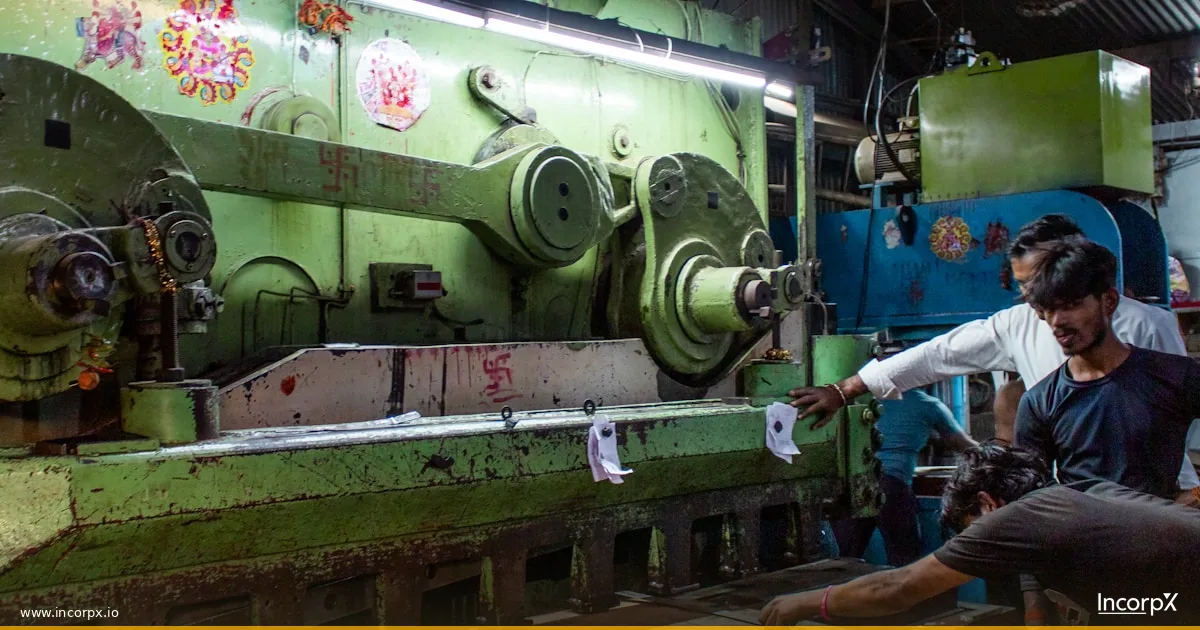
The Production Linked Incentive (PLI) Scheme is India's most ambitious industrial policy programme since liberalisation, directing ₹1.97 lakh crore in incentives across 14 manufacturing sectors over a 5-year period. Launched by the Union Cabinet in November 2020 after a successful pilot in mobile manufacturing, the PLI Scheme rewards companies that meet incremental production and investment targets with cash incentives of 4% to 6% of net sales. By March 2024, approved beneficiaries had reported cumulative production of ₹8.61 lakh crore, investment of ₹1.23 lakh crore, and creation of over 8.5 lakh jobs. Whether you are a startup exploring manufacturing for the first time or an established company planning capacity expansion, this guide covers the complete list of 14 PLI sectors, eligibility criteria, registration process, incentive rates, and the step-by-step claim procedure.
- PLI Scheme covers 14 sectors with a total budgetary outlay of ₹1.97 lakh crore over 5 years
- Incentive rates range from 4% to 6% of incremental sales (up to 20% for drones)
- Both MSMEs and large manufacturers can apply; minimum investment starts at ₹2 crore for drones
- As of 2024, PLI has attracted ₹1.23 lakh crore in investment and generated 8.5 lakh+ jobs
- Applications are submitted online through sector-specific ministry portals
- Annual incentive claims require audited sales data, GST returns, and PMA verification
What Is the Production Linked Incentive (PLI) Scheme?
The Production Linked Incentive Scheme is a central government initiative designed to boost domestic manufacturing by providing financial incentives tied to incremental production. Unlike capital subsidy programmes that reimburse a percentage of investment regardless of output, PLI rewards actual manufacturing activity. Companies that exceed a defined base-year production threshold receive cash incentives as a percentage of their incremental sales for up to 5 years.
The scheme was first introduced in March 2020 for mobile manufacturing and specified electronic components under the Ministry of Electronics and Information Technology (MeitY). The initial success led the Union Cabinet to expand PLI to 13 additional sectors in November 2020, bringing the total to 14 sectors. The Department for Promotion of Industry and Internal Trade (DPIIT) under the Ministry of Commerce and Industry acts as the nodal coordinating body for the overall PLI programme.
The core objective is threefold: (1) make India a global manufacturing hub by attracting large-scale investment, (2) reduce import dependence in critical sectors like electronics, pharma, and defence, and (3) create employment at scale. The ₹1.97 lakh crore allocation represents one of the largest fiscal commitments to industrial manufacturing in India's post-independence history.
How PLI Differs from Other Government Incentive Schemes
PLI is fundamentally different from schemes like the Modified Special Incentive Package Scheme (M-SIPS), Technology Upgradation Fund Scheme (TUFS), or capital subsidy programmes under state industrial policies. These traditional schemes provide incentives based on investment made, irrespective of whether the factory produces anything. PLI ties every rupee of incentive to actual production and sales, creating a direct link between government spending and manufacturing output.
This design also distinguishes PLI from Startup India tax benefits, which are profit-linked (Section 80-IAC), and from MSME subsidies that focus on technology adoption. PLI incentivises scale, not just establishment, making it suitable for both greenfield projects and brownfield expansion by existing manufacturers.
Complete List of 14 PLI Sectors with Budget Allocation
Each of the 14 PLI sectors has a dedicated nodal ministry, a defined budgetary outlay, and sector-specific eligibility criteria. The table below provides the complete sector-wise breakdown as approved by the Union Cabinet.
| Sr. No. | Sector | Nodal Ministry | Outlay (₹ Crore) |
|---|---|---|---|
| 1 | Mobile Manufacturing and Electronic Components | MeitY | 40,951 |
| 2 | Critical Drug Intermediaries and APIs | Dept. of Pharmaceuticals | 6,940 |
| 3 | Manufacturing of Medical Devices | Dept. of Pharmaceuticals | 3,420 |
| 4 | Automobiles and Auto Components | Ministry of Heavy Industries | 25,938 |
| 5 | Pharmaceuticals (Drug Formulations) | Dept. of Pharmaceuticals | 15,000 |
| 6 | Specialty Steel | Ministry of Steel | 6,322 |
| 7 | Telecom and Networking Products | Dept. of Telecom | 12,195 |
| 8 | Electronic/Technology Products | MeitY | 5,000 |
| 9 | White Goods (ACs and LEDs) | DPIIT | 6,238 |
| 10 | Food Processing | Ministry of Food Processing | 10,900 |
| 11 | Textiles (MMF and Technical Textiles) | Ministry of Textiles | 10,683 |
| 12 | High-Efficiency Solar PV Modules | MNRE | 24,000 |
| 13 | Advanced Chemistry Cell (ACC) Battery | Ministry of Heavy Industries | 18,100 |
| 14 | Drones and Drone Components | Ministry of Civil Aviation | 120 |
The total approved outlay is approximately ₹1,97,807 crore (around USD 26 billion). Individual sector budgets may be revised upward based on demand. The mobile manufacturing PLI alone accounts for over 20% of the total allocation.
Eligibility Criteria for PLI Scheme Registration
While each sector sets its own specific thresholds, several eligibility conditions are common across all 14 PLI sectors. Understanding these baseline criteria is essential before preparing your application.
Common Eligibility Requirements
- Legal Entity: The applicant must be a company registered under the Companies Act, 2013 (Private Limited, Public Limited, or Section 8 company). Partnership firms and proprietorships are not eligible. If you have not incorporated yet, register your company first
- Manufacturing in India: The production facility must be located in India. Companies with existing factories can apply for brownfield expansion; new entrants can apply for greenfield projects
- Incremental Investment: Applicants must commit to a minimum incremental investment in plant, machinery, and equipment above the base-year level. The amount varies from ₹2 crore (drones) to ₹250 crore+ (automobiles)
- Incremental Sales Threshold: Companies must achieve a minimum level of incremental sales over the base year to qualify for incentive disbursement each year
- GST Compliance: Active GST registration is mandatory. Sales data verified through GST returns forms the basis for incentive calculation
- Financial Track Record: Most sectors require audited financial statements for the preceding 3 years. New companies may need to provide a detailed business plan and financial projections
Sector-Specific Minimum Investment Thresholds
| Sector | Applicant Category | Minimum Investment | Incentive Rate |
|---|---|---|---|
| Mobile Manufacturing | Global Companies | ₹200 crore | 4% to 6% |
| Mobile Manufacturing | Domestic Companies | ₹50 crore | 4% to 6% |
| Automobiles | Champion OEM | ₹250 crore+ | Up to 18% (new energy vehicles) |
| Automobiles | Component Manufacturers | ₹5 crore to ₹150 crore | Up to 13% |
| Food Processing | Large Enterprise | ₹50 crore | 4% to 6% |
| Food Processing | SME Category | ₹10 crore | 4% to 6% |
| Pharma (Drug Formulations) | All Categories | Varies by product | 3% to 10% |
| Drones | All Manufacturers | ₹2 crore | 20% of value addition |
| Solar PV Modules | All Manufacturers | Per GW capacity basis | Capacity-linked incentive |
| Specialty Steel | All Categories | Varies by grade | 4% to 12% |
Step-by-Step PLI Scheme Registration Process
The PLI application process follows a structured workflow managed by the nodal ministry for each sector. While specific portal URLs and timelines vary, the overall registration process is consistent across all 14 sectors.
- Step 1 - Company Incorporation: Ensure your entity is registered as a Private Limited or Public Limited company under the Companies Act, 2013. Obtain a valid Certificate of Incorporation, PAN, TAN, and GST registration. This step takes 7 to 10 working days through IncorpX's registration service
- Step 2 - MSME Registration (if applicable): If your company qualifies as a Micro, Small, or Medium Enterprise, obtain Udyam registration. Several PLI sectors have dedicated SME categories with lower investment thresholds
- Step 3 - Prepare Financial Documents: Gather audited financial statements for the past 3 years, current GST returns (GSTR-1, GSTR-3B), bank statements, and investment proof. New companies should prepare a detailed business plan with 5-year financial projections
- Step 4 - Monitor Application Windows: Each sector announces application windows through gazette notifications and ministry websites. Track announcements on the DPIIT website, the nodal ministry's PLI portal, and the Press Information Bureau (PIB)
- Step 5 - Online Application Submission: Register on the sector-specific PLI portal. Fill in the application form with company details, investment plan, production capacity, target product categories, and manufacturing facility details. Upload all required documents including the board resolution authorising the application
- Step 6 - Application Review and Approval: The Project Management Agency (PMA) appointed for each sector reviews applications. This includes verification of financial documents, site inspection (for some sectors), and assessment of the investment plan. The review period typically takes 30 to 60 working days
- Step 7 - Approval Letter and Agreement: Approved applicants receive an approval letter from the nodal ministry. The company signs a formal agreement with the Government of India, committing to the investment and production targets specified in the application
- Step 8 - Commence Manufacturing: Begin or scale manufacturing operations as per the investment plan. Maintain detailed production records, sales invoices, GST filings, and investment documentation for annual verification
Application windows have strict deadlines. Missing the window means waiting for the next round, which may not be announced. Some sectors like mobile manufacturing and ACC batteries have already completed their primary application rounds. Check the nodal ministry portal for any extension or additional application windows.
How to Claim PLI Incentives After Approval
Receiving PLI approval is only the first step. The actual incentive disbursement requires annual compliance verification and a formal claim submission process. Companies must demonstrate that they have met both investment and production targets for each incentive year.
Annual Incentive Claim Process
- Complete the Incentive Year: Each PLI sector defines incentive years (typically aligned with financial years). The company must achieve the minimum incremental sales threshold for that specific year
- Prepare Claim Documentation: Compile audited production and sales figures, GST returns (GSTR-1 and GSTR-3B) for the claim period, bank realisation certificates for export sales, and a certified statement of incremental investment
- Submit Claim on PLI Portal: Upload the claim package on the sector-specific portal within the prescribed deadline (typically 90 days after the end of the incentive year)
- PMA Verification: The Project Management Agency conducts desk verification and may perform a physical inspection of the manufacturing facility. The PMA cross-checks production data with GST filings and bank statements
- Incentive Disbursement: After PMA approval, the nodal ministry releases the incentive amount directly to the company's bank account. Disbursement typically occurs within 60 to 90 days after claim verification is complete
Key Documents for Annual Claims
- Audited Financial Statements: Profit and loss statement and balance sheet certified by a Tax Professional
- GST Returns: Monthly GSTR-1 and GSTR-3B filings for the entire claim period
- Investment Proof: Invoices, bank statements, and Expert certificate for incremental capital expenditure on plant and machinery
- Production Records: Factory production logs, quality certificates, and inventory records
- Sales Evidence: Domestic sales invoices and export realisation certificates from authorised dealer banks
Engage a Virtual CFO from the first year of PLI operations. Proper financial documentation from Day 1 prevents claim rejections and delays. Many companies lose incentive payouts due to incomplete or inconsistent records between GST returns and audited financials.
Sector-Wise PLI Scheme Performance (2024 Update)
As of March 2024, the PLI Scheme has delivered measurable results across most approved sectors. The DPIIT's annual PLI progress report shows strong traction in mobile manufacturing, pharma, and food processing, while newer sectors like ACC batteries and specialty steel are still ramping up.
- Mobile Manufacturing: PLI beneficiaries have produced goods worth ₹5.33 lakh crore since inception. Apple's contract manufacturers (Foxconn, Pegatron, Tata Electronics) have made India a top-5 global iPhone production hub. Mobile phone exports crossed ₹1.2 lakh crore in FY 2023-24
- Pharma and Medical Devices: 55 companies approved under pharma PLI have invested over ₹4,100 crore and generated sales of ₹32,000 crore in FY 2023-24. India has reduced API import dependence from China by 12% for critical drug intermediaries
- Food Processing: 170+ companies approved with investment commitments of ₹8,000 crore. Major beneficiaries include ITC, Nestle India, Britannia, and Parle. The scheme has boosted processed food exports by 18% year-on-year
- Automobiles: 85 approved companies across Champion OEM and component categories. Focus areas include electric vehicles, hydrogen fuel cells, and advanced automotive technology. Investments of ₹14,000 crore reported through FY 2023-24
- Specialty Steel: 57 companies approved with production of 42 lakh tonnes of specialty steel valued at ₹27,000 crore. This has reduced imports of coated steel, high-strength steel, and stainless steel products
PLI Scheme Benefits for Manufacturers
The PLI Scheme delivers five categories of direct and indirect benefits to participating manufacturers, making it one of the most comprehensive industrial incentive programmes in India.
Direct Financial Incentives
The primary benefit is the cash incentive of 4% to 6% of incremental sales (up to 20% for drones). For a company achieving incremental sales of ₹500 crore at a 5% incentive rate, the annual payout is ₹25 crore, directly improving operating margins. Over the 5-year incentive period, cumulative payouts can reach ₹100 crore or more for large manufacturers, significantly offsetting capital investment costs.
Reduced Import Dependence
By incentivising domestic production of items currently imported (electronic components, APIs, specialty steel, solar cells), the PLI Scheme strengthens India's supply chain resilience. Mobile phone imports dropped from ₹48,609 crore in FY 2017-18 to ₹11,747 crore in FY 2023-24, a 76% reduction directly attributable to PLI-driven domestic manufacturing.
Employment Generation
PLI-approved projects have generated over 8.5 lakh direct and indirect jobs across all sectors. The employment multiplier is strongest in labour-intensive sectors like textiles, food processing, and electronics assembly. Each ₹1 crore of PLI incentive disbursed has created approximately 4.3 jobs on average.
Export Competitiveness
PLI beneficiaries gain a cost advantage that makes Indian products competitive in global markets. Electronics exports from India grew 35% year-on-year in FY 2023-24, driven primarily by PLI beneficiaries. The government's goal is to achieve ₹4 lakh crore in electronics exports by FY 2025-26.
PLI Scheme for Key Sectors: Detailed Overview
Mobile Manufacturing and Electronic Components
The flagship PLI sector with the largest allocation of ₹40,951 crore. Approved beneficiaries include Samsung, Foxconn (for Apple), Pegatron, Wistron (now Tata Electronics), Dixon Technologies, Lava International, and Padget Electronics. The scheme offers 4% to 6% incentive on incremental sales above the FY 2019-20 base year. India's mobile phone production reached ₹4.1 lakh crore in FY 2023-24, making it the world's second-largest mobile phone manufacturer by volume.
Automobiles and Auto Components
With ₹25,938 crore in outlay, the automobile PLI targets advanced automotive technologies (AAT) including electric vehicles, hydrogen fuel cells, and connected vehicle systems. The scheme has two categories: Champion OEM (minimum investment ₹250 crore) and Component Champion (₹5 crore to ₹150 crore). Incentive rates go up to 18% for new energy vehicle components, significantly higher than other PLI sectors.
High-Efficiency Solar PV Modules
Allocated ₹24,000 crore to build domestic solar cell and module manufacturing capacity. India currently imports over 80% of solar cells and modules, primarily from China. The PLI targets integrated manufacturing from ingot/wafer to cell to module. Approved capacity includes projects by Adani Solar, Tata Power Solar, Reliance New Energy, and Vikram Solar, with combined manufacturing commitments of 48,000 MW (48 GW).
Advanced Chemistry Cell (ACC) Battery
With ₹18,100 crore, this PLI sector supports domestic lithium-ion and advanced battery cell manufacturing. Approved manufacturers include Ola Electric, Reliance New Energy, Rajesh Exports, and Amara Raja. The total approved capacity is 50 GWh of ACC manufacturing. This is critical for India's electric vehicle transition and energy storage ambitions.
Common Mistakes to Avoid in PLI Applications
Based on data from the first three years of PLI implementation, several common mistakes lead to application rejections or claim delays. Avoiding these errors improves your chances of both approval and timely incentive disbursement.
- Applying as a non-company entity: Partnership firms, LLPs, and proprietorships are not eligible. Ensure you have a valid company registration before applying
- Incorrect base-year calculations: Using the wrong base year or including ineligible product categories in the base-year sales figure leads to rejection during PMA verification
- GST return discrepancies: If your GST returns do not match the production and sales figures submitted in the PLI claim, the PMA will flag the application. Maintain consistent records across all filings
- Missing application deadlines: PLI application windows are time-bound. Missing the deadline by even one day means waiting for the next round, which may not be announced for 12 to 18 months
- Inadequate investment documentation: Capital expenditure on plant and machinery must be substantiated with invoices, bank payment proof, and a Expert certificate. Verbal commitments or MoUs without actual expenditure do not count
- Not maintaining separate books: Some sectors require separate accounting for PLI-eligible production versus non-eligible production. Mixed accounting leads to verification complications and claim delays
Over 15% of annual PLI claims face initial rejection due to documentation gaps, particularly mismatches between GST returns and audited financials. Companies should reconcile all records quarterly rather than attempting year-end corrections. Engage professional compliance services to maintain audit-ready records throughout the year.
Tax Implications of PLI Incentives
PLI incentives have specific tax treatment under the Income Tax Act that companies must account for in their financial planning and annual returns.
Corporate Tax on PLI Income
PLI incentives received by a company are classified as business income and taxed at the applicable corporate tax rate. New manufacturing companies incorporated on or after 1 October 2019 that opt for the Section 115BAB concessional regime pay 15% tax (plus surcharge and cess, effective rate approximately 17.16%) on PLI income. Companies under the regular regime pay 22% (effective rate approximately 25.17%) under Section 115BAA, or 30% under the old regime.
GST Treatment
PLI incentives are treated as subsidies and are not subject to GST as they are not consideration for any supply of goods or services. However, the production itself remains subject to applicable GST rates. Companies must ensure correct HSN classification of PLI-eligible products and file accurate GST returns, as these returns serve as primary verification documents for incentive claims.
Capital Expenditure Deductions
Investment in plant and machinery made for PLI compliance qualifies for depreciation under the Income Tax Act. Companies can claim depreciation at the prescribed rates (15% for general plant and machinery, higher for specific assets). Additionally, Section 32AD provides an investment allowance of 15% for new plant and machinery installed in notified backward areas, which can be combined with PLI benefits. Companies setting up new manufacturing units for PLI should evaluate the Section 115BAB (15% tax) regime before commencing operations, as once opted, the concessional rate applies for the life of the company. Consult a Virtual CFO to model the net benefit after accounting for PLI income, depreciation, and foregone deductions under the old regime.
PLI Scheme and MSME Registration: Dual Benefits
Micro, Small, and Medium Enterprises registered under the Udyam portal can access multiple benefits by combining MSME registration with PLI participation. Several PLI sectors explicitly create SME categories with lower investment and production thresholds.
- Lower Entry Barriers: Food processing PLI allows SME applicants with just ₹10 crore investment versus ₹50 crore for large enterprises. Drones PLI requires only ₹2 crore
- Priority Lending: Banks provide priority sector lending at lower interest rates (typically 1% to 2% below standard rates) to MSME units, reducing the cost of capital for PLI-required investments
- Government Procurement Preference: MSME-registered PLI beneficiaries get preference in government procurement under the Public Procurement Policy, 2012, with 25% procurement reserved for MSMEs
- Credit Guarantee: The Credit Guarantee Fund Trust for Micro and Small Enterprises (CGTMSE) provides collateral-free loans up to ₹5 crore, which can fund initial PLI-related capital expenditure
- Technology Upgradation: MSME units can access CLCS-TUS (Credit Linked Capital Subsidy and Technology Upgradation Scheme) for 15% capital subsidy on technology upgradation, stackable with PLI incentives
Compliance Requirements for PLI Beneficiaries
PLI approval comes with ongoing compliance obligations that companies must fulfil throughout the 5-year incentive period. Non-compliance in any year can result in loss of incentives for that year and potential deselection from the scheme.
Annual Compliance Checklist
- Quarterly Production Reports: Submit production volume and value data on the PLI portal every quarter. Some sectors require monthly reporting
- Annual Investment Verification: Provide certified statements of incremental capital expenditure on plant, machinery, and equipment
- GST Return Filing: Timely filing of GSTR-1, GSTR-3B, and annual returns (GSTR-9). Any default in GST filing can delay or disqualify incentive claims
- Audited Financial Statements: Submit audited financials within 6 months of the financial year end, with specific disclosures on PLI-related production and sales
- PMA Inspections: Cooperate with scheduled and surprise inspections by the Project Management Agency. Maintain production records accessible for verification at all times
- Employment Reporting: Some sectors require reporting on direct employment generated by PLI-eligible operations, including EPF and ESI registration data
- Annual Return Filing: File annual returns with the Registrar of Companies (ROC), including Form AOC-4 and Form MGT-7, on time. Company-level compliance defaults can jeopardise PLI standing
Failure to meet minimum incremental investment or production thresholds for 2 consecutive years can trigger deselection from the PLI scheme. Once deselected, a company cannot re-apply under the same sector window. Maintain a compliance calendar and engage professional compliance services to track all deadlines.
How to Maximise PLI Incentive Claims
Simply meeting minimum thresholds leaves significant incentive value on the table. Strategic planning across production, documentation, and financial structure can maximise your annual PLI payout.
- Front-Load Investment: Complete capital expenditure early in the incentive period. This allows higher production capacity sooner, generating larger incremental sales and higher cumulative incentives over 5 years
- Focus on High-Value Products: PLI incentives are calculated on sales value, not volume. Shifting the product mix toward higher-value items (premium models, value-added variants) increases the incentive per unit produced
- Build Export Markets: Export sales count toward incremental sales for PLI calculation. Building international distribution channels adds a revenue stream that boosts PLI claims without cannibalising domestic sales
- Maintain Real-Time Records: Use ERP-integrated production tracking that reconciles with GST filings automatically. This eliminates year-end reconciliation issues that cause claim rejections
- Engage Professionals Early: A Virtual CFO can structure your financials to maximise PLI claims while ensuring compliance. The cost of professional services is far outweighed by the incremental incentive captured through proper documentation
Future of the PLI Scheme: Expansion and Updates
The Government of India has indicated continued commitment to the PLI framework with potential expansion to additional sectors and increased budgets for high-performing sectors.
Potential New Sectors
Industry bodies have recommended PLI extension to semiconductor packaging and testing, toys manufacturing, furniture and home decor, leather goods, and defence electronics. The India Semiconductor Mission, announced separately with a ₹76,000 crore outlay, follows a similar incentive-linked structure. The semiconductor programme covers fab establishment, display fab, compound semiconductors, and ATMP (Assembly, Testing, Marking, and Packaging) units.
PLI 2.0 for Existing Sectors
The government is considering PLI 2.0 extensions for high-performing sectors, particularly mobile manufacturing and electronics. These extensions would offer incentives beyond the initial 5-year window for companies that continue scaling production. The IT hardware PLI has already been extended with revised targets and timelines.
Additionally, the Atmanirbhar Bharat policy framework positions PLI as a long-term industrial strategy rather than a one-time scheme. Budget allocations for manufacturing incentives have increased in each successive Union Budget since 2020, signalling sustained fiscal support for domestic production.
Conclusion
The PLI Scheme for 14 sectors represents a ₹1.97 lakh crore opportunity for Indian manufacturers to scale operations, capture incentives of 4% to 6% of incremental sales, and position themselves in global supply chains. With over ₹1.23 lakh crore in investment already committed and 8.5 lakh jobs created, the scheme has proven its ability to drive real manufacturing growth. The registration process requires careful preparation of financial documents, company incorporation, and timely application submission through sector-specific portals.
Whether you are an MSME exploring the ₹2 crore entry-level drones PLI or a large manufacturer targeting the ₹25,938 crore automobile programme, the first step is the same: ensure your company is properly incorporated, GST-compliant, and financially documented. At IncorpX, we handle company registration, MSME registration, GST compliance, and ongoing financial management to keep you PLI-ready from Day 1.











 Ashwin Raghu
 Nebin Binoy
