Drone Business Registration in India: DGCA License, UIN, and UAS Rules 2026
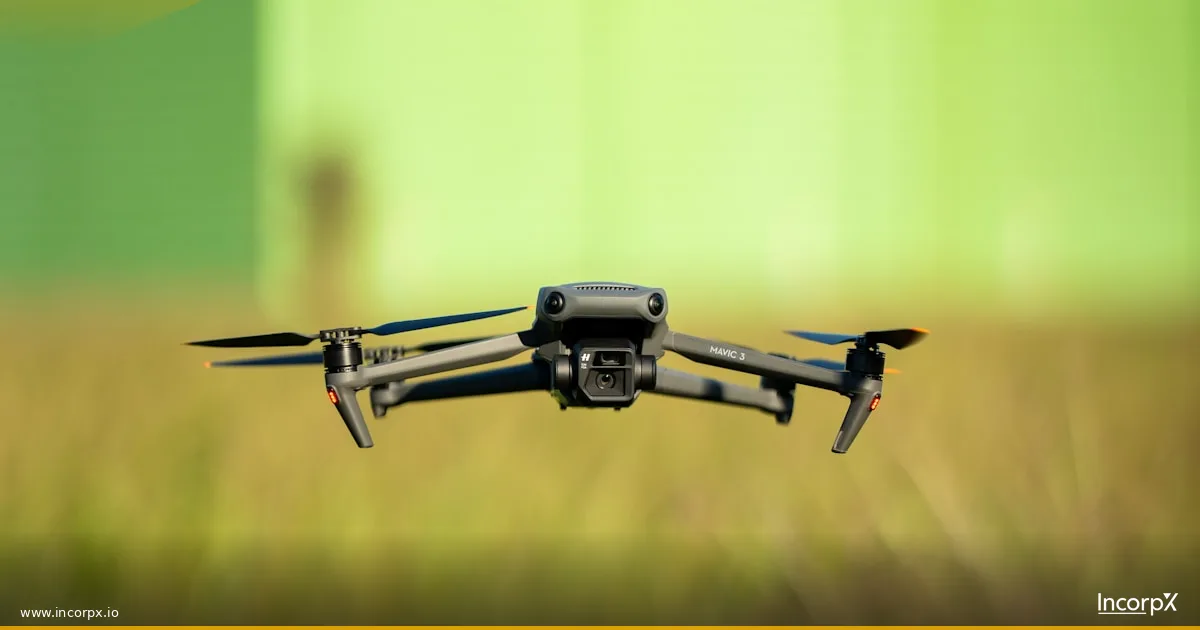
India's drone sector is projected to reach a market value of ₹15,000 crore by 2030, driven by government policy reforms, the PLI scheme for domestic manufacturing, and expanding commercial applications in agriculture, infrastructure, logistics, and defence. The UAS Rules, 2021, published by the Ministry of Civil Aviation, replaced the earlier restrictive 2018 regulations with a liberalised framework that cuts compliance layers, reduces fees, and opens the sector to startups and MSMEs. Starting a drone business in India now requires navigating a defined set of registrations: company incorporation, DGCA drone registration on the DigitalSky platform, Unique Identification Number (UIN), Remote Pilot License (RPL), type certification, and sector-specific permits. This guide covers every registration, licence, and compliance requirement a drone entrepreneur needs, from entity formation through operational clearance, with exact fees, timelines, and regulatory references valid for 2025-2026.
- UAS Rules, 2021 classify drones into five weight-based categories: Nano, Micro, Small, Medium, and Large
- All drones except Nano (below 250 g, flying under 50 feet) require UIN registration on the DGCA DigitalSky platform
- Remote Pilot License is mandatory for commercial drone operations in Micro (above 2 kg), Small, Medium, and Large categories
- Private Limited Company is the recommended structure for drone startups due to funding, liability, and government contract eligibility
- PLI scheme allocates ₹120 crore for drone and drone component manufacturing incentives at 20% of value addition
- 100% FDI is permitted under the automatic route for drone manufacturing and services
- Penalties for unregistered drone operations reach ₹1 lakh, with criminal prosecution possible under the Aircraft Act, 1934
Drone Industry in India: Market Size and Regulatory Timeline
The Indian drone market was valued at approximately ₹3,500 crore in 2023 and is forecast to grow at a compound annual growth rate (CAGR) of 28% to 33% through 2030. Agriculture accounts for the largest use case at 35% of commercial drone deployments, followed by infrastructure and construction (25%), energy and utilities (15%), mining and surveying (10%), and logistics and delivery (8%). The defence and security segment, while representing 7% of commercial volume, commands a disproportionate share of value due to high unit costs of military-grade drones.
The regulatory timeline for drones in India has moved through three distinct phases. The Civil Aviation Requirements (CAR) of 2018 established the first formal framework but imposed 25 approval layers and was widely criticised as impractical. The UAS Rules, 2021, notified on 25 August 2021, replaced the 2018 framework with a liberalised regime: abolished the requirement for security clearance, type certificate fee, remote pilot licence fee, import clearance, and several other approvals. The Drone (Amendment) Rules, 2022 and subsequent circulars further simplified processes, including extending the deadline for NPNT compliance and creating exemptions for government drone operations. As of 2025, DGCA continues to issue operational circulars refining the framework, with full NPNT enforcement and Digital Sky 2.0 updates expected in 2026.
Employment and Startup Activity
The drone sector directly employed over 30,000 people in India as of 2024, across manufacturing, operations, training, and support services. Over 350 drone startups have received DPIIT recognition, with more than 60 funded through venture capital rounds. Notable Indian drone companies span agriculture spraying, beyond-visual-line-of-sight (BVLOS) delivery, drone-as-a-service platforms, and indigenous defence drone manufacturing. The government's Drone Shakti initiative and the inclusion of drones in the PM-Kisan scheme for agricultural spraying have further expanded the addressable market for new entrants.
UAS Rules, 2021: The Core Regulatory Framework
The Unmanned Aircraft System Rules, 2021, are the primary legislation governing drone registration, operation, and manufacturing in India. Notified under the Aircraft Act, 1934, these rules apply to all unmanned aircraft systems (UAS) operating in Indian airspace, whether owned by individuals, companies, government bodies, or foreign nationals with appropriate permissions.
The UAS Rules, 2021 cover nine key areas: (1) classification of drones by weight, (2) registration and UIN issuance, (3) type certificate and airworthiness, (4) Remote Pilot Licence requirements, (5) operational limitations and airspace zones, (6) RPAS Operator Permit for commercial organisations, (7) research and development permissions, (8) import and manufacturing standards, and (9) penalties for violations. The rules replaced the 25-layer approval process under the 2018 CAR with a simplified digital-first framework administered entirely through the DigitalSky platform.
Drone Categories Under Indian Regulations
India classifies all unmanned aircraft into five categories based on maximum all-up weight (AUW), which includes the drone airframe, payload, battery, and all attachments at the time of takeoff. Each category has distinct registration, licensing, and operational requirements. Understanding your drone's category is the first step in determining compliance obligations.
| Category | Maximum All-Up Weight | UIN Required | Remote Pilot License | Type Certificate | Common Applications |
|---|---|---|---|---|---|
| Nano | Up to 250 g | No (below 50 ft in uncontrolled airspace) | No | No | Hobby, indoor photography, education |
| Micro | 250 g to 2 kg | Yes | Required for commercial operations | No | Real estate photography, small-area surveys |
| Small | 2 kg to 25 kg | Yes | Yes | Yes | Agriculture spraying, mapping, construction monitoring |
| Medium | 25 kg to 150 kg | Yes | Yes | Yes | Heavy-payload delivery, industrial inspection, defence |
| Large | Above 150 kg | Yes | Yes | Yes | Cargo delivery, military operations, long-range surveillance |
Most commercial drone businesses in India operate in the Small category (2 kg to 25 kg), which covers the widest range of applications including agriculture, surveying, infrastructure inspection, and aerial photography. The regulatory burden for this category is moderate: UIN registration, RPL, type certificate, and third-party insurance are all mandatory, but the process is handled digitally through DigitalSky. Nano drones, while exempt from most regulations, have limited commercial viability due to payload and range constraints.
Step-by-Step DGCA Drone Registration on the DigitalSky Platform
The DigitalSky platform (digitalsky.dgca.gov.in) is the single-window portal for all drone-related registrations, permissions, and compliance in India. Every drone owner, operator, manufacturer, and pilot interacts with this platform. The registration process follows a defined sequence.
Step 1: Create a DigitalSky Account
Register on the DigitalSky portal using Aadhaar-linked credentials (for individuals) or the company's authorised representative details (for organisations). You need a valid mobile number, email address, and identity proof. For companies, the portal requires the CIN (Corporate Identity Number), registered office address, and director details. This account serves as the master identity for all subsequent registrations.
Step 2: Register as a Drone Operator
After account creation, register as a drone operator by selecting the operator type (individual, company, government entity) and submitting Form D-3. For commercial operations through a company, you need the Certificate of Incorporation, PAN, GST certificate, and a letter of authorisation for the designated person managing drone operations. DGCA reviews the operator registration within 7 working days.
Step 3: Register the Drone and Obtain UIN
Submit Form D-2 for each drone unit with the following details: drone manufacturer, model, serial number, all-up weight, type certificate number (for Small, Medium, and Large categories), proof of purchase or ownership, and third-party insurance policy. DGCA verifies the details against the type certificate database and issues the Unique Identification Number (UIN) within 15 working days. The UIN is a permanent alphanumeric identifier physically affixed to the drone and linked to the DigitalSky database.
Step 4: File Flight Plans and Obtain Permissions
Before each flight, operators file a flight plan on DigitalSky specifying the date, time, location (GPS coordinates), altitude, duration, and purpose of the flight. The platform cross-references the location against the airspace map (green, yellow, red zones) and issues automated clearance for green zones. Yellow zones require approval from the Air Traffic Control (ATC) authority, while red zones are prohibited. The NPNT system on the drone verifies the clearance before allowing motor arming.
Register Your Drone Company with IncorpX
Company incorporation is the first step before DGCA registration. IncorpX handles Pvt Ltd formation, PAN, TAN, and GST registration for drone startups in 7 to 10 days.
Start Your Drone Company RegistrationUnique Identification Number (UIN) and Operator Permit
The UIN is the drone equivalent of a vehicle registration number. It is a mandatory alphanumeric code assigned to each drone unit and must be physically displayed on the drone body. The UIN links the drone to its owner, operator, type certificate, and insurance policy in the DigitalSky database. Operating a drone without a valid UIN is a violation under Rule 37 of the UAS Rules, 2021.
For organisations conducting commercial drone operations, an RPAS Operator Permit is required in addition to individual drone UINs. The Operator Permit certifies that the organisation has the necessary infrastructure, trained personnel, standard operating procedures (SOPs), safety protocols, and insurance coverage to conduct drone operations. The application requires submission of the company's operational manual, safety management system documentation, list of registered drones, and details of licensed remote pilots on the payroll.
The UIN registration is valid for 10 years from the date of issue and must be renewed before expiry. Any change in ownership requires a fresh UIN application. If the drone is deregistered (due to sale, export, or destruction), the owner must file a deregistration notice on DigitalSky within 30 days. Failure to deregister transfers ongoing compliance liability to the registered owner.
Remote Pilot License: Eligibility, Training, and Examination
The Remote Pilot License (RPL) is the qualification that authorises an individual to operate drones in regulated categories. Under UAS Rules 2021, the RPL is mandatory for operating drones in the Small (2 kg to 25 kg), Medium (25 kg to 150 kg), and Large (above 150 kg) categories, and for commercial operations of Micro category drones above 2 kg. The RPL is issued by DGCA after the candidate completes training at an approved RPTO and passes the DGCA examination.
Eligibility Requirements
Candidates must meet the following criteria: (1) minimum age of 18 years and maximum 65 years, (2) completion of Class 10 education (for Small category) or Class 12 with physics and mathematics (for Medium and Large categories), (3) valid Class 2 medical certificate from a DGCA-approved medical examiner, (4) no criminal convictions related to aviation safety, narcotics, or terrorism, and (5) Indian citizenship or valid residence permit. Foreign nationals must obtain a temporary authorisation from DGCA for drone operations in India.
RPTO Training Programme
The candidate must enrol at a DGCA-approved Remote Pilot Training Organisation (RPTO). As of 2025, DGCA has approved over 30 RPTOs across India offering training for different drone categories. The training syllabus includes ground instruction (aviation meteorology, air regulations, drone systems, navigation, emergency procedures, and radio communication) and practical flying sessions (pre-flight checks, takeoff, hover, waypoint navigation, return-to-home, emergency landing, and payload operations). Minimum training hours are 25 hours ground instruction and 10 hours practical flying for the Small category. Medium and Large categories require additional hours.
DGCA Examination
After completing RPTO training, the candidate appears for the DGCA-conducted computer-based examination. The exam covers air regulations, meteorology, drone technology, navigation, and emergency procedures. A score of 75% or above is required to pass. Candidates who fail can reattempt after 15 days with a maximum of 4 attempts within 24 months of completing training. Upon passing, DGCA issues the RPL within 7 working days. The licence is valid for 10 years and renewable subject to medical fitness and no enforcement actions.
Type Certificate and Airworthiness Requirements
A Type Certificate (TC) is a DGCA-issued certification confirming that a specific drone model meets the prescribed design, manufacturing, and safety standards under the UAS Rules, 2021. Type certificates are mandatory for drones in the Small (2 kg to 25 kg), Medium (25 kg to 150 kg), and Large (above 150 kg) categories. Nano and Micro drones are exempt from type certification.
The type certificate is issued to the drone manufacturer, not to individual owners. When purchasing a drone for commercial use, verify that the specific model holds a valid DGCA Type Certificate. For imported drones, the foreign manufacturer must either obtain a DGCA Type Certificate directly or hold a certificate from the civil aviation authority of the country of manufacture that DGCA recognises through bilateral agreements. The type certificate confirms compliance with structural integrity standards, propulsion system reliability, battery safety, electromagnetic interference limits, maximum speed and altitude constraints, NPNT compatibility, and fail-safe mechanisms (return-to-home, geofencing, auto-land).
The airworthiness certificate is a separate document issued for each individual drone unit after it passes a physical inspection. While the type certificate covers the model, the airworthiness certificate confirms that the specific unit conforms to the type design and is safe to fly. This is analogous to the relationship between vehicle homologation (type approval) and individual vehicle fitness certification in the automobile sector.
Business Entity Registration for a Drone Company
Before applying for any DGCA registrations, the drone entrepreneur must establish a legal business entity. The choice of entity affects liability protection, fundraising capability, government contract eligibility, and PLI scheme qualification. The following entity types are available, but the Private Limited Company is the clear choice for most drone businesses.
A Private Limited Company provides limited liability to its shareholders, separating personal assets from business liabilities. This is critical in the drone sector where operational risks (crashes, property damage, personal injury) can generate significant third-party claims. The Pvt Ltd structure also allows equity investment through share issuance, making it compatible with venture capital and angel funding rounds. For drone startups planning to apply for DPIIT recognition under the Startup India scheme, the company must be a Private Limited Company, LLP, or registered partnership firm.
Drone companies bidding for government contracts (defence, agriculture, survey, smart city) typically need a Private Limited Company or LLP status. Government procurement portals (GeM, BEL tenders) require a valid CIN, GST registration, and audited financial statements, all of which are standard for incorporated entities. For PLI scheme eligibility, the manufacturing entity must be a company registered under the Companies Act, 2013.
Entity Registration Checklist
The following registrations are required for a fully compliant drone company: (1) Company incorporation with MCA and CIN allotment, (2) PAN and TAN from the Income Tax Department, (3) GST registration for interstate or above-threshold supply, (4) MSME/Udyam registration for government tender preferences and priority lending, (5) DPIIT Startup India recognition for tax exemptions and fast-track IP, (6) Professional Tax registration (state-specific), (7) Shops and Establishment licence (state-specific), and (8) Import-Export Code (IEC) if importing drones or components.
Get All Business Registrations in One Package
IncorpX bundles company incorporation, GST, MSME, PAN, TAN, and Startup India registration for drone companies. One point of contact, one timeline.
GST, MSME, and Tax Registrations for Drone Businesses
Drone businesses attract Goods and Services Tax at rates that vary by activity type. Drone manufacturing falls under the HSN code applicable to the finished product classification, typically attracting 18% GST. Drone services (aerial survey, photography, mapping, inspection, spraying) attract 18% GST under SAC code 998599 (other professional and technical services). Drone pilot training services by RPTOs may attract 18% GST unless exempted under the educational services exemption for courses recognised by a government authority.
Input Tax Credit (ITC) is available on drone purchases, components, batteries, ground control stations, software licences, insurance premiums, and training costs incurred in the course of business. This makes GST registration advantageous even below the ₹20 lakh threshold if the business incurs significant input costs. A drone company purchasing equipment worth ₹15 lakh before starting commercial operations can claim the entire ITC upon filing returns after registration.
MSME registration under the Udyam portal is strongly recommended. Drone manufacturing startups with investment up to ₹1 crore and turnover up to ₹5 crore qualify as Micro enterprises. MSME registration provides: (1) access to the Credit Guarantee Fund Scheme (CGTMSE) for collateral-free loans up to ₹5 crore, (2) 3% interest subvention on bank loans, (3) preference in government procurement (25% reservation for MSME suppliers on GeM), (4) protection against delayed payments under the MSMED Act, and (5) technology upgradation support under the CLCSS scheme. Combined with Startup India recognition, a drone startup can access tax exemptions under Section 80-IAC (3 years of income tax holiday out of the first 10 years) and fast-tracked patent filing.
PLI Scheme and Government Incentives for Drone Manufacturing
The Production Linked Incentive (PLI) scheme for drones and drone components was approved by the Union Cabinet on 15 September 2021, with a total financial outlay of ₹120 crore spread across three financial years. The scheme incentivises domestic manufacturing by providing a cash incentive of up to 20% of the value addition achieved on drone and drone component production above the base year revenue threshold.
PLI Eligibility and Covered Products
Eligible applicants must be companies registered under the Companies Act, 2013, with a minimum annual revenue threshold from drone or drone component manufacturing. The scheme covers the complete drone ecosystem: airframes, propulsion systems (motors, ESCs, propellers), power systems (batteries, fuel cells), avionics (flight controllers, GPS modules, communication systems), cameras and sensors (LiDAR, multispectral, thermal), ground control stations, and counter-drone systems. The minimum value addition threshold is 40% of net sales for drones and 50% for components, ensuring that assembly-only operations without genuine manufacturing do not qualify.
Beyond the PLI scheme, drone businesses benefit from multiple government incentives: (1) Customs duty exemption on certain drone components under the DGFT notification, (2) BIS standards for drones (IS 18539:2024) establishing quality benchmarks for domestic manufacturers, (3) DRDO-supported R&D grants for defence-grade drone development through iDEX (Innovations for Defence Excellence), and (4) state-level incentives from IT/startup policies in Karnataka, Telangana, Tamil Nadu, Maharashtra, and Gujarat that provide capital subsidies, land allotments, and tax holidays for drone manufacturing units.
| Scheme | Incentive Type | Amount / Benefit | Eligibility |
|---|---|---|---|
| PLI for Drones | Cash incentive on value addition | Up to 20% of value addition | Companies registered under Companies Act, 2013 |
| Startup India (Section 80-IAC) | Income tax exemption | 3 out of 10 years tax holiday | DPIIT-recognised startups, turnover below ₹100 crore |
| CGTMSE | Collateral-free loan guarantee | Loans up to ₹5 crore | MSME-registered entities |
| iDEX (Defence) | R&D grant + procurement commitment | Grants up to ₹1.5 crore per project | Startups and MSMEs working on defence tech |
| Drone Shakti | Government procurement pipeline | Multi-year contracts for DraaS | DGCA-registered drone operators |
| MSME Interest Subvention | Reduced loan interest rate | 3% subvention on bank loans | Udyam-registered MSMEs |
Airspace Restrictions, No-Fly Zones, and Insurance
Indian airspace for drone operations is divided into three colour-coded zones on the DigitalSky platform. Green zones (up to 400 feet AGL in uncontrolled airspace) allow flights with prior intimation on DigitalSky and no separate ATC clearance. Yellow zones (controlled airspace, near airports, near helipads) require advance ATC permission filed through DigitalSky. Red zones (airports, military installations, international borders, Vijay Chowk in Delhi, state secretariats, nuclear facilities, eco-sensitive areas) are permanently restricted and no civilian drone operations are permitted without specific clearance from the Ministry of Defence or Home Affairs.
Specific No-Fly Zone Restrictions
Drones are prohibited from operating within: (1) 5 kilometres of the perimeter of any airport (civil or military), (2) the area within the 25-km radius of an international border (except with MEA/MHA clearance), (3) the Vijay Chowk in Delhi (permanent NOTAM restriction), (4) within 3 km of any military installation or firing range, (5) eco-sensitive zones as notified by the Ministry of Environment, (6) strategic locations as published in the NOTAM database, and (7) above 400 feet AGL without specific DGCA and ATC clearance. Temporary restrictions are published through NOTAMs during VIP movements, national events, and security situations. Operators must check DigitalSky airspace maps before every flight.
Insurance Requirements
Third-party liability insurance is mandatory for all drone operations except Nano drones flying below 50 feet. The insurance must cover damage to third-party persons and property arising from drone operations, including crashes, component failures, and battery fires. Coverage amounts are not specified in the UAS Rules but must be adequate for the operational risk profile. Commercial drone operators typically maintain coverage of ₹25 lakh to ₹1 crore per incident. Insurance providers include New India Assurance, ICICI Lombard, and specialised aviation insurance underwriters. Annual premiums range from ₹5,000 to ₹50,000 depending on drone value, category, and operational scope. Proof of valid insurance is required for UIN registration and renewal on DigitalSky.
Penalties for Drone Violations Under UAS Rules, 2021
The penalty framework under UAS Rules, 2021 and the Aircraft Act, 1934, covers both administrative fines and criminal prosecution. The severity depends on the nature of the violation, the drone category, and whether the violation caused harm to persons, property, or aviation safety.
Administrative penalties under the UAS Rules include: (1) operating without UIN registration: penalty up to ₹1 lakh, (2) flying in restricted airspace without permission: ₹50,000 to ₹5 lakh and drone seizure, (3) operating without a valid Remote Pilot License: up to ₹1 lakh, (4) failure to maintain mandatory insurance: up to ₹50,000, (5) non-compliance with NPNT requirements: up to ₹1 lakh, and (6) failure to file flight plans: up to ₹25,000 per instance.
Criminal penalties under the Aircraft Act, 1934 apply when drone operations endanger manned aircraft, persons on the ground, or national security. Section 11A of the Aircraft Act provides for imprisonment up to 2 years, a fine up to ₹10 lakh, or both for flying an aircraft in a manner that endangers the safety of any person. Multiple incidents of drone interference near airports have led to FIRs under these provisions. Customs authorities can also prosecute under the Customs Act for illegally imported drones operated without clearance.
FDI Policy and Import Regulations for Drones
India permits 100% Foreign Direct Investment (FDI) under the automatic route for drone manufacturing, drone services, and drone component manufacturing. No prior approval from the Reserve Bank of India or any government ministry is required for foreign investors. This policy, effective since the liberalisation of UAS Rules in 2021, has attracted significant international investment into Indian drone companies, particularly in the agricultural drone and defence drone segments.
Drone import policy has been progressively simplified. The 2021 reforms eliminated the mandatory security clearance from the Ministry of Home Affairs (MHA) for civilian drone imports. The current process requires: (1) a valid Importer Exporter Code (IEC) from DGFT, (2) import under the applicable HSN code with customs duty payment (basic customs duty ranges from 0% to 18% depending on the component), (3) DGCA type certificate for the imported model, and (4) compliance with BIS standards where applicable. Complete drone units (HSN 8806) attract a total import duty of approximately 18% to 25% including IGST. Drone components imported for manufacturing in India may qualify for concessional duty under FTA benefits or specific DGFT notifications.
For defence-related drone imports, the process involves additional clearance from the Directorate General of Armaments (DGA) and end-user certification. The Make in India initiative actively discourages defence drone imports in favour of domestic procurement, with the Ministry of Defence publishing a positive indigenisation list that includes several drone categories for mandatory domestic sourcing.
Stay Compliant with Ongoing Drone Regulations
IncorpX provides annual compliance management for drone companies, covering GST returns, income tax, ROC filings, and regulatory updates.
Explore Compliance PackagesFinancial Planning and Virtual CFO Services for Drone Startups
Drone businesses face unique financial planning challenges: high upfront capital expenditure on equipment, seasonal revenue patterns (agriculture spraying is monsoon-dependent), complex GST calculations across manufacturing and service activities, and multi-layered compliance costs. A structured financial framework from inception prevents cash flow crises and ensures regulatory compliance.
The capital expenditure for a typical Small-category commercial drone operation includes: drone units (₹3 lakh to ₹15 lakh per unit), spare batteries and accessories (₹50,000 to ₹2 lakh), ground control station (₹1 lakh to ₹3 lakh), data processing software (₹30,000 to ₹2 lakh per year), insurance (₹15,000 to ₹50,000 per drone per year), and pilot training (₹50,000 to ₹1 lakh per pilot). Total initial investment ranges from ₹8 lakh to ₹25 lakh for a single-drone operation and ₹30 lakh to ₹1 crore for a multi-drone fleet targeting government contracts.
A Virtual CFO service helps drone startups with: (1) financial modelling for PLI scheme applications (value addition calculations, revenue projections), (2) optimising input tax credit claims across GST categories (manufacturing vs. services), (3) structuring the capital table for equity fundraising, (4) managing working capital during seasonal demand fluctuations, (5) preparing audited financials for government tender eligibility, and (6) tax planning around Section 80-IAC exemptions and depreciation on drone assets. Given that drone assets depreciate rapidly (useful life of 3 to 5 years), proper depreciation scheduling under the Income Tax Act is essential for accurate profit reporting.
Compliance Checklist for Starting a Drone Business in India
The following table consolidates every registration, licence, and compliance step required to launch a fully operational drone business in India. Use this as a master checklist with estimated timelines for each step.
| Step | Registration / Licence | Authority | Timeline | Cost Estimate |
|---|---|---|---|---|
| 1 | Private Limited Company registration | MCA (Ministry of Corporate Affairs) | 7 to 10 days | ₹7,000 to ₹15,000 |
| 2 | PAN and TAN | Income Tax Department | Issued with incorporation | Included in incorporation |
| 3 | GST registration | GSTN | 3 to 7 days | No government fee |
| 4 | MSME/Udyam registration | Udyam portal | Same day | Free |
| 5 | DPIIT Startup India recognition | DPIIT | 2 to 4 weeks | Free |
| 6 | DigitalSky operator registration | DGCA | 7 working days | No fee |
| 7 | Drone UIN registration | DGCA (DigitalSky) | 15 working days | Nominal (category-based) |
| 8 | Remote Pilot License (RPL) | DGCA via RPTO | 4 to 6 weeks (training + exam) | ₹25,000 to ₹1,00,000 |
| 9 | Third-party insurance | Insurance provider | 1 to 2 weeks | ₹5,000 to ₹50,000 per year |
| 10 | Import-Export Code (if importing) | DGFT | 3 to 5 days | ₹500 (government fee) |
| 11 | State Shop and Establishment licence | State Labour Department | 7 to 15 days | ₹500 to ₹3,000 |
| 12 | Professional Tax registration | State Government | 3 to 7 days | State-specific |
Steps 1 through 5 (business registrations) can run in parallel with steps 6 through 8 (DGCA registrations) to compress the total timeline to 10 to 12 weeks. The critical path runs through Remote Pilot License training (4 to 6 weeks), which should be initiated early. Company incorporation and GST registration should be completed first, as the CIN and GSTIN are required for the DigitalSky operator registration in Step 6.
Get Expert Help with Your Drone Business Setup
From company registration to DGCA compliance planning, IncorpX supports drone entrepreneurs at every stage. Talk to our startup advisory team for a customised roadmap.






 Nebin Binoy